As air-raid sirens sound across countries bordering Ukraine, and coinciding with the latest Russian attacks near the Polish border, regions and cities representatives gathered in Cáceres, Spain to…

At the 2023 LEADER Congress, local and regional leaders highlighted that LEADER should be adequately financially supported and implemented in a simplified way.
More than 800 representatives from local action groups across Europe met on 18-19 December at the 2023 LEADER European Congress, hosted by the European Committee of the Regions (CoR), to discuss the role of rural development in shaping Europe's future. The conference, which was held six months before elections to the European Parliament, provided a platform for stakeholders to exchange ideas and experiences, address the challenges faced by rural areas, and advocate for a stronger focus on rural development in EU policy.
The conference was chaired by Thibaut Guignard, head of the European LEADER Association for Rural Development (ELARD) and of LEADER France, and member of the CoR. LEADER is a methodology used for the past 30 years to involve local actors in the creation and implementation of local development strategies, and the conference brought together representatives from local, regional, national and European levels of government, including members of the CoR, the European Economic and Social Committee, and the European Parliament. The CoR was represented by Isilda Gomes, chair of the CoR's Commission for Natural Resources (NAT) and Radim Sršeň, vice-chair of NAT.
The CoR, which has long advocated for the visibility and inclusion of rural areas and their inhabitants in European policies, welcomed the European Commission's adoption of a long-term vision for rural areas. However, local and regional representatives urged the Commission to set more tangible targets and quantitative objectives, backed up by dedicated funding. Members of NAT also emphasised the need for rural areas to be considered in all European policies, arguing also that the digital, green and demographic transitions cannot be achieved without the involvement of rural areas. They noted that the EU's resilience in the face of recent crises is partly attributable to the contributions of rural communities.
Local development strategies implemented through LEADER play an important role in meeting the needs of rural areas in fields such as employment, social inclusion, rural services, and rural economies' innovation and competitiveness. The work of LEADER networks is part-financed by the EU. The CoR has called on EU institutions and Member States for access to the LEADER programmes to be simplified.
In an
opinion on the future of cohesion policy after 2027 adopted last month, the CoR calls for the restoration of the future fund of the Common Agricultural Policy (CAP) supporting agricultural rural development; such a fund should be managed regionally, placing greater emphasis on structural policy measures in sparsely populated areas. The opinion also demands the reinforcement of Community Led Local Development (CLLD) under cohesion policy to finance non-agricultural rural development.
European LEADERS Awards 2023
NAT Chair, Isilda Gomes is a member of the Jury for the
European LEADERS Awards 2023, which rewards the most impactful and innovative European projects of the 2014-2020 programme, and highlights concrete achievements funded by the LEADER 2014-2020 programme. Winners were congratulated during the Congress:
Quotes
Isilda Gomes (PT/PES), mayor of Portimão and chair of NAT, opened the Congress and said: "The projects rewarded today show that the true European added value can be found in every territory of the EU thanks to LEADER. But if LEADER is expected to do more with less, there is an urgent need to simplify, coordinate and harmonize access to European funding for rural development."
Radim Sršeň (CZ/EPP), mayor of the Municipality of Dolní Studénky, vice-chair of NAT, recently elected as chair of the Rural Pact Coordination Group, said: "LEADER is one of the best programmes invented by the European Union which has proven to be a very successful and effective integrated tool of local development. It has been able to activate and engage all key stakeholders and citizens and through bottom-up approach bring Europe to every living room. However, it is now crucial to spread this approach from just agricultural policy to all other policies! Just multifund, multisectoral and multipolicy LEADER/CLLD approach with sufficient resources can help to the transformation of rural areas to solve huge challenges they are facing, especially the green, digital and demographic ones."
Thibaut Guignard (FR/EPP), mayor of Plœuc-l'Hermitage, chair of LEADER France and chair of ELARD, said: "LEADER has been one of the successes of the European Union for 30 years with a method, local development by local actors (CLLD) and tangible and recognised results. However, we cannot meet all the challenges of rural areas with only 5% of the EAFRD. We therefore need adequate financial resources. This could involve an increase in the share of the EAFRD dedicated to LEADER or through a simplified multi-fund."
Background
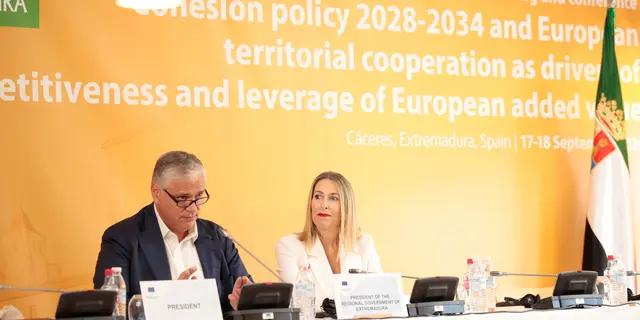
As air-raid sirens sound across countries bordering Ukraine, and coinciding with the latest Russian attacks near the Polish border, regions and cities representatives gathered in Cáceres, Spain to…
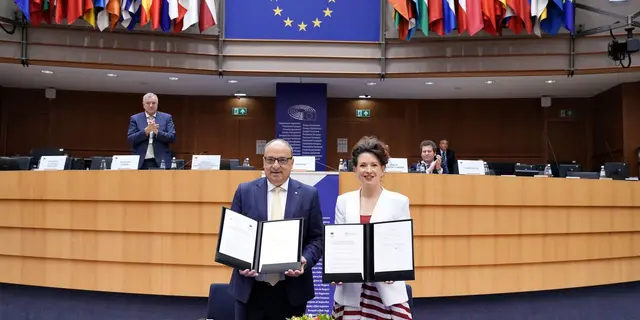
The European Committee of the Regions (CoR) and the Conference of Cantonal Governments of Switzerland (CCG) signed a Memorandum of Understanding (MoU) on 2 July 2026, during the CoR plenary session.
Local and regional authorities must be formally involved in the EU's future internal security instrument for 2028–2034. This is the core message of the opinion Union support for internal…