Leden van de commissie Natuurlijke Hulpbronnen (NAT) van het Europees Comité van de Regio’s (CvdR) kwamen op 1 en 2 oktober bijeen in Castilla-La Mancha, Spanje, om het toenemende risico op…
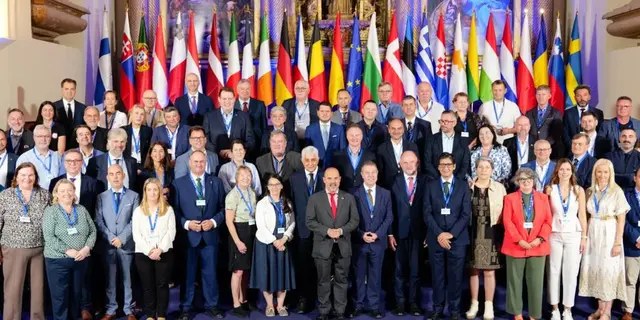

Green Deal Going Local working group members believe cities and regions are key allies in ensuring public support for Green Deal 2.0.
There is a need to increase support to farmers to comply with the European Green Deal regulations and to reduce red tape around them, members of the European Committee of the Regions stressed at the Green Deal Going Local working group meeting on 25 January.
The two co-rapporteurs of an upcoming CoR opinion on the future of the Common Agricultural Policy (CAP) believe that regionalising the management of the CAP would help to identify better and react to the problems that farmers are facing and that have led to protests across Europe in recent weeks. The CAP should also move away from hectare-based direct payments to a model based on work-intensity and environmental sustainability, supporting smaller producers and rural development as whole.
Isilda Gomes (PT/PES), Mayor of Portimão and Chair of the CoR's Commission for Natural Resources (NAT), said: "We stand by the side of farmers. They are currently struggling with the complexity of European and national rules. To support them embracing the ecological transition – that means increasing agriculture's resilience, securing good farmers' revenue and quality food - let's give more power to the regions."
Piotr Całbecki (PL/EPP), President of the Kujawsko-Pomorskie Region, said: "Current protests across Europe don't happen because farmers are against the Green Deal, they are against economic inequalities. Farmers can't just be given orders to implement laws, they must receive support and compensation, and we need to listen to and support them. Our objective should be a more regionalised and socially fair CAP that benefits farmers, employment, rural areas and biodiversity."
Members taking the floor highlighted the links between the CAP, biodiversity and sustainable food systems and pointed out that the transition from intensive modes to nature respecting solutions takes time and requires stable financing. The discussions feeding into the opinion will continue at the NAT Commission meeting on 5 February.
Towards Green Deal 2.0
During the meeting, the members of the working group also exchanged views on the importance of preparedness and climate resilience, following a series of adverse climate events impacting cities and regions across Europe in recent months. Speakers underlined the cost of non-action and the need to push ahead with climate mitigation measures coupled with adaptation/resilience actions, and the need to swiftly conclude negotiations on key Green Deal files still pending.
Against the backdrop of rising populism ahead of the European elections, members stressed that regions and cities are key allies in ensuring public support to Green Deal related policies. The Green Deal Going Local working group is preparing a set of recommendations for Green Deal 2.0 in view of the EU elections and the new strategic agenda for the EU. These draft recommendations will be further elaborated in a high-level debate at the European Summit of Regions and Cities in Mons on 18-19 March and adopted at the next working group meeting on 29 May. The CoR and the European Parliament will also host a Belgian Presidency high-level event on Translating the EU Green Deal into local action on 15 March.
Kata Tüttö (HU/PES), Deputy Mayor of Budapest and vice-chair of the CoR's Commission for Environment, Climate Change and Energy (ENVE), said: "During these four years the Green Deal Going Local provided a permanent space for the political debate through a cross-cutting approach to the Committee's extensive work on the EU's path towards climate neutrality. This comprehensive work shows that the issue of its long-term governance is crucial to preserve the ambition and the successful implementation of the future Green Deal, which needs a strong social dimension and requires to fully involve local and regional authorities."
More information: Green Deal Going Local working group 2024 roadmap
Leden van de commissie Natuurlijke Hulpbronnen (NAT) van het Europees Comité van de Regio’s (CvdR) kwamen op 1 en 2 oktober bijeen in Castilla-La Mancha, Spanje, om het toenemende risico op…
Distretto Sardegna Bio in Italië en Cussac-Fort-Médoc in Frankrijk ontvingen tijdens een ceremonie in Brussel op 23 september ter gelegenheid van de Europese dag van de biologische productie de EU…
