Wioletta Wojewodzka
Wioletta.wojewodzka@cor.europa.eu

The CoR Subsidiarity Conference held in Warsaw delivers a roadmap to strengthen European democracy and enhance the involvement of cities and regions in EU policies.
Highlighting the importance of better regulation, the European Committee of the Regions (CoR) is calling for stronger cooperation between EU institutions, greater involvement of regional and local authorities in the legislative process, and the promotion of policies that foster economic, social, and territorial cohesion. The CoR is committed to enhancing active subsidiarity, multilevel governance and better regulation, thereby ensuring that EU policies and laws have a tangible impact on the ground.
This is the message by local and regional representatives from across the EU meeting in Warsaw, Poland, for the 11th Subsidiarity Conference organised by the European Committee of the Regions (CoR) at the invitation of the President of the Mazovia region, Adam Struzik (PL/EPP).
In the European Union, active subsidiarity implies that all levels of government, including cities and regions are involved in EU-decision making and implementation. In today's conference, the members of the CoR adopted conclusions affirming that active subsidiarity is a key democratic and legal principle as well as an essential ingredient of policies aiming to achieve fair and inclusive transitions and competitive.
Looking ahead at the new EU policy and legislative cycle, the CoR called on all EU institutions to give cities and regions a real place at the table when it comes to discussing the design and implementation of EU laws and policies throughout the better-regulation life cycle.
Concerning the EU budget and resources devoted to cohesion policy in particular, cities and regions reject any attempt to centralise the EU's long-term budget post-2027 and urge instead a restructuring based on the principles of active subsidiarity, partnership and multilevel governance. They firmly emphasised that cohesion policy is "non-negotiable".
With regards to the future of the EU, local leaders fully supported the European Parliament's call for Treaty reform and for the European Council to convene a Convention in which the CoR should participate.
Patrick Molinoz (FR/PES), Vice-president of the Bourgogne-Franche-Comté region and Chair of the CoR commission for Citizenship, Governance, Institutional and External Affairs (CIVEX), emphasised the need for a shared vision between EU institutions. He also stressed the importance of strengthening the CoR's inter-institutional role. "Local and regional authorities are facing a crucial agenda that will put the European Union as such at risk. Three challenges appear to be real imperatives: first, safeguarding the cohesion policy objectives and means in the definition of the Union's priorities, which cannot be pursued without respect for the principles of subsidiarity, proportionality and partnership; second, ensuring that these principles are taken into account in the review of European policies with a view to accompanying the pre-enlargement reform process; third, to adapt – that is, to increase – European budget through own-resources mechanisms."
Antje Grotheer (DE/PES), President of Bremen Parliament and Chair of the CoR Better Regulation and Active Subsidiarity Steering Group (BRASS-G), reiterated the central role of regions and cities in shaping EU decisions that reflect local realities. "Subsidiarity is about which level is best at doing what and how all levels need to be involved to achieve good EU policies. The CoR works hard to provide input from the local and regional levels on what is needed on the ground and how to run policies effectively."
Adam Struzik, President of the Mazovia region, said: "At the moment, important discussions and arrangements for the new EU perspective after 2027 are taking place in Brussels. There is an ongoing discussion about how the fundamental principle of the European Union – the principle of subsidiarity – is to be implemented. We are discussing how the policy of equalising the development of more than 280 European regions will be carried out. How will regional and local development be supported? There are many challenges, such as security issues or the development of digitisation. On the one hand, we need to actively spend European funds in the current agenda, on the other hand we are fighting for the greatest possible support in the next perspective."
The Chair of the CoR commission for environment, Climate change and Energy (ENVE), Rafal Trzaskowski (PL/EPP), Mayor of Warsaw, underlined the CoR's role in promoting active subsidiarity in environmental and climate legislation. "The effective implementation of the European Green Deal requires multilevel governance since cities and regions are responsible for implementing 70% of climate mitigation measures and 90% of climate adaptation policies. The EU's local and regional governments account for around 58% of climate-significant public expenditure, surpassing their national governments. This is effective application of the subsidiarity principle."
Background
The Subsidiarity Conference is a biennial event that seeks to strengthen the EU inter-institutional dialogue on subsidiarity scrutiny and to allow for a meaningful exchange between institutions and stakeholders involved in active subsidiarity and better-regulation activities. The 11th conference builds on the outcomes of the Conference on the Future of Europe, on the recommendations of the CoR Better Regulation and Active Subsidiarity Steering Group (BRASS-G), and on the findings of the CoR opinion on 'Active subsidiarity: a fundamental principle in the EU better regulation agenda'.
The CoR's annual report on the State of Regions and Cities in the European Union 2024 emphasises the role of regions and cities in shaping policies and calls for stronger partnerships on an equal footing with the EU and national levels, reflecting the principle of active subsidiarity. Local and regional authorities call for the CoR to have a greater role in EU governance, particularly for territorial policies, and emphasise the need for decentralisation and multilevel governance in future reforms.
Webstreaming and photos of the meeting.
Wioletta.wojewodzka@cor.europa.eu
The President of the European Committee of the Regions (CoR), Kata Tüttő, will on 12 October present the CoR's 2026 report on the 'State of Regions and Cities'.
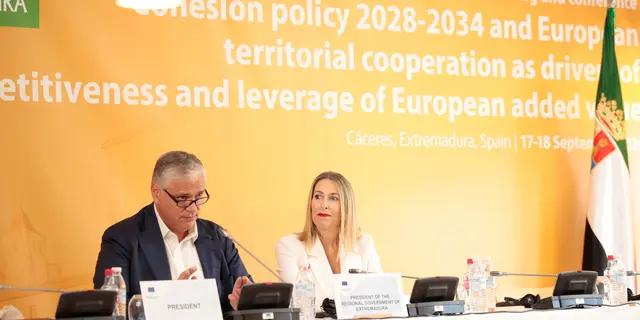
As air-raid sirens sound across countries bordering Ukraine, and coinciding with the latest Russian attacks near the Polish border, regions and cities representatives gathered in Cáceres, Spain to…
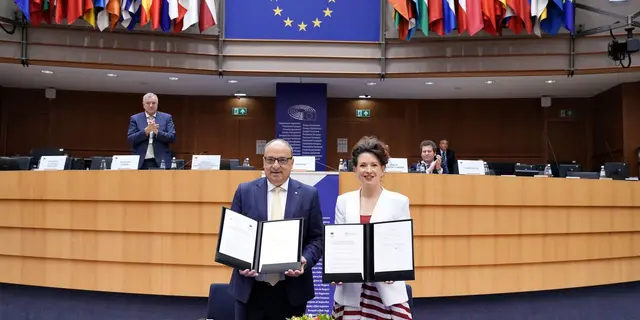
The European Committee of the Regions (CoR) and the Conference of Cantonal Governments of Switzerland (CCG) signed a Memorandum of Understanding (MoU) on 2 July 2026, during the CoR plenary session.