Víctor Moreno Morales de Setién
victor.morenomoralesdesetien@cor.europa.eu
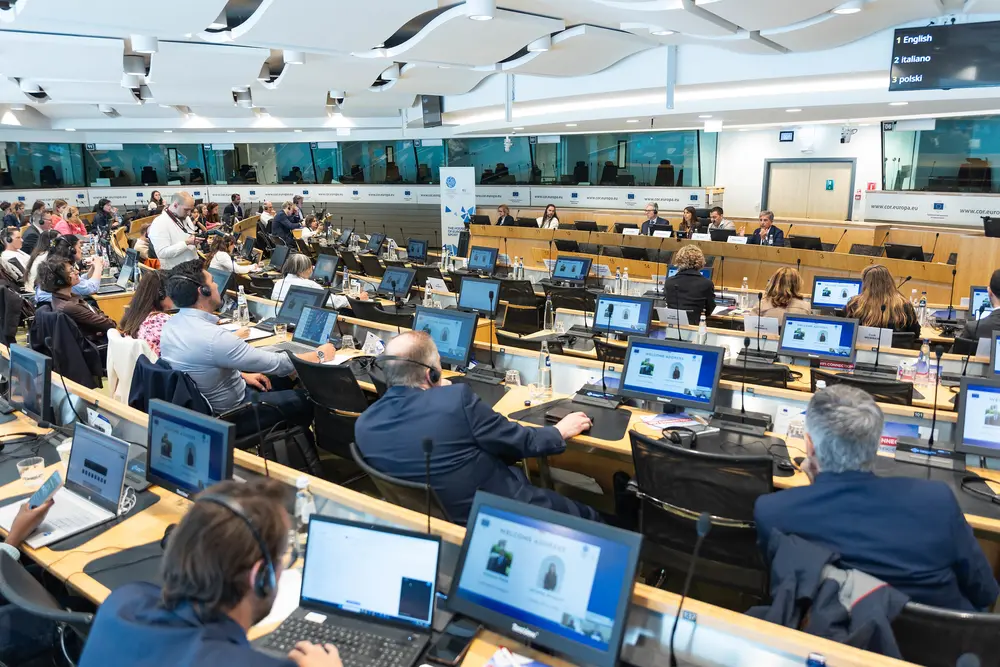
The European Committee of the Regions (CoR) and the European Olympic Committees (EOC) have urged EU co-legislators to embed sport across all Multiannual Financial Framework (MFF) 2028–2034 funding instruments and to ensure that sports organisations have direct, simplified access to EU funds.
Sport is a strategic investment for a stronger and more resilient Europe, they argue. Every €1 invested in sport generates around €5 in socio-economic benefits, and the sector contributes 2.12% of EU GDP. At the same time, physical inactivity places an estimated €80 billion annual burden on European healthcare systems, underlining the cost of underinvesting in physical activity.
During an event held in the CoR on 4 June, entitled 'The enabling role of sport to achieve EU objectives and future support via the MFF 2028–2034', the CoR and the EOC called for sport to be mainstreamed across multiple EU policy areas under a 'sport in all policies' approach. Whilst support through the future Erasmus+ programme remains the most evident and accessible route for sport organisations to contribute to EU policy priorities, the extent to which the enabling role of sport will be recognised within the broader MFF — particularly in the National and Regional Partnership Plans (NRPPs), the European Regional Development Fund (ERDF) and the European Social Fund (ESF+) — remains under discussion. Participants called for clarity and ambition on this front.
They further requested that direct and simplified access to funding be guaranteed at national, regional and local level, and that the contribution of sport organisations to health, social inclusion, youth engagement and regional development be explicitly acknowledged within the MFF 2028–2034 architecture.
Among the speakers, CoR members Sari Rautio (FI/EPP) and Roberto Pella (IT/EPP) — respectively, rapporteurs on the MFF and on sport and Erasmus+ — underlined the importance of sport as a vehicle for cooperation, growth and social cohesion. MEP Bogdan Zdrojewski (PL/EPP) highlighted Erasmus+ as a key driver of inclusion and stressed the need to protect and increase its share within the next MFF. MEP Sabrina Repp (DE/PES) pointed to sport as a foundation for achieving the objectives of cohesion policy, building community, and fostering participation and trust. Meanwhile, EOC Executive Committee (ExCom) member Annamarie Phelps highlighted the unique power of sport as a vehicle to help achieve the EU’s most pressing priorities and model the behaviours the EU wants to encourage.
The conference opened with project examples illustrating the tangible impact of EU-funded sport initiatives at local and regional level. Representatives from Denmark and Slovenia demonstrated how National Olympic Committees (NOCs) have drawn on Erasmus+ Sport, the ERDF and the ESF+ funds to support regional development and attractiveness, as well as public health, whilst opening up opportunities for young people and pathways to employment. Tiago Carvalho, member-at-large of the European Paralympic Committee, highlighted how para-sport initiatives across Europe have delivered inclusion outcomes that extend well beyond the sport sector itself.
The discussion sought to shape how sport is recognised and supported within the European Union for the decade to come, highlighting the need for the contribution of NOCs, sport federations and grassroots sport organisations to cities and regions to be better reflected in EU funding frameworks and for organised sport stakeholders to be recognised as key partners in delivering lasting benefits for local communities across Europe.
Quotes
Sari Rautio (FI/EPP), CoR rapporteur on the MFF and member of the Hämeenlinna City Council: "Sport has two important dimensions. Of course, it has its own intrinsic value, but sport is also a powerful tool — a tool for cooperation, for co-creation, for learning together, and for building trust. And these are exactly the things we need in the times we are living through today."
Roberto Pella (IT/EPP), CoR rapporteur on Sport and on Erasmus+ and mayor of Valdengo: "Erasmus+ is not just a programme for mobility, education and sport; it is a cornerstone of our shared identity, which we must always strive to strengthen. Stronger partnerships, along with technical capacity-building programmes in the most vulnerable areas, are needed to enable all communities — including those in the most peripheral and inner areas — to benefit fully from the role of sport in promoting inclusion and social cohesion. In this regard, the sporting dimension of all European programmes should be strengthened, in line with a 'sport in all policies' approach, recognising the educational and social value that sport brings every day at regional, provincial and municipal levels."
MEP Sabrina Repp (DE/PES),European Parliament shadow rapporteur on NRPPs: "Sport creates community, participation and trust, especially in rural areas where young people often have fewer opportunities. This is exactly why future cuts to cohesion policy would be so damaging. If EU funding for social projects, local infrastructure and rural development is weakened, many clubs, municipalities and youth initiatives will lose the support they need. Europe must not save money at the expense of the places that hold our communities together. We need strong cohesion policy, a strong ESF+, and reliable investment in regions, young people and civil society."
Annamarie Phelps, member of the EOC Executive Committee: "Sport is a powerful and cost-effective tool for delivering European priorities. National Olympic Committees, Federations, clubs and volunteers contribute to inclusion, health, education, sustainability and community resilience, while European sport events create lasting social and economic legacies for cities and regions. The next Multiannual Financial Framework must recognise this contribution by explicitly integrating sport across relevant funding instruments and enabling sport organisations to play their full role as a driver of social impact, regional development and community resilience across Europe."
Prof. Dr. Maja Zalaznik, Chair of the International Commission, National Olympic Committee of Slovenia and member of the & EOC EU Commission Member: "Sport organisations deliver where governments alone cannot. The projects presented today demonstrated how sport organisations can reach and engage people and communities that public institutions sometimes struggle to connect with. When sport organisations and local authorities work hand-in-hand, they can create tangible benefits for citizens, cities and regions, both on and off the field of play. Because sport brings multiple societal benefits, it should be supported across multiple funding instruments in the MFF."
Background
Contact
Víctor Moreno Morales de Setién
Tel: +32 475 999 662
victor.morenomoralesdesetien@cor.europa.eu
victor.morenomoralesdesetien@cor.europa.eu


The President of the European Committee of the Regions (CoR), Kata Tüttő, will on 12 October present the CoR's 2026 report on the 'State of Regions and Cities'.
As air-raid sirens sound across countries bordering Ukraine, and coinciding with the latest Russian attacks near the Polish border, regions and cities representatives gathered in Cáceres, Spain to…
The European Committee of the Regions (CoR) and the Conference of Cantonal Governments of Switzerland (CCG) signed a Memorandum of Understanding (MoU) on 2 July 2026, during the CoR plenary session.