Regions are key to making the industrial transformation a success and boosting Europe's defence capabilities. This was the main message highlighted by regional and local leaders as they gave the…
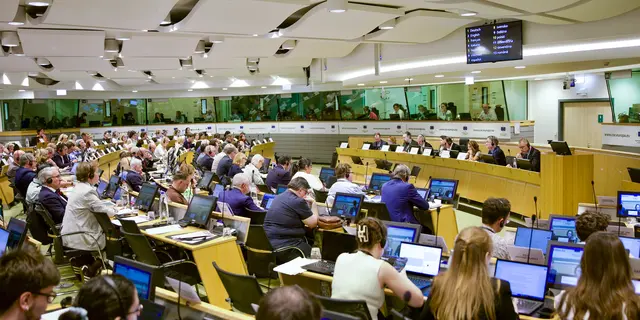

The European Committee of the Regions (CoR) gave its backing on 31 January to a package of support measures for small and medium-sized enterprises (SMEs) proposed by the European Commission but stressed that measures need more local focus and faster implementation.
In an opinion drafted by Kate Feeney (IE/Renew) from Dún Laoghaire-Rathdown County Council and adopted by unanimity by CoR members during their plenary session, the CoR welcomed proposed measures to simplify administrative procedures for companies doing business across the Single Market, in part through digitalisation.
Increasing SMEs competitiveness and resilience can only be achieved by boosting innovation
CoR members stressed that most European SMEs are investing in their sustainable transition, though they generally struggle with accessing finance and skills for this and with related reporting requirements. To address the finance gap for the green transition, the capacity of banks to fulfil sustainable financing should be substantially increased through incentives and simplified regulation.
Warning that SMEs face an increasing challenge to find skilled employees, the CoR argued that many key skills for the green and digital transition of European industry are best brought to SMEs by regional partnerships, networks, and clusters, and called for the EU to work closely with local and regional governments and provide funding. The package also includes new tools to foster innovation at the regional level. Regional and local leaders welcomed the proposals, but also suggested the European Commission could go farther, by teaming up with European regions and cities to explore and pilot innovative ideas.
Simplified regulations are crucial to provide stable growth strategies
Regional and local governance levels play an important role in the development of a sound and business-friendly entrepreneurial ecosystem, through the provision of stable and simple regulations based on a targeted, collaboratively elaborated SME and start-up growth strategy.
Increased digitalisation is essential for SME competitiveness, resilience and ability to innovate and it can significantly improve the functioning of the EU Single Market by reducing related administrative costs and burdens on businesses. Local and regional leaders therefore stressed that European SMEs would benefit from stronger links between the digitalisation and the better regulation agenda in the public sector, by engaging local and regional actors in finding innovative regulatory solutions.
On a common problem faced by European businesses – late payments by customers – the CoR gave a mixed response to European Commission's proposals. Local and regional leaders were wary of a suggestion to impose strict and uniform rules of payments for all businesses across the EU, suggesting instead a phased rollout of standardised rules, with public authorities leading by example by improving their payment practices.
Quote:
Rapporteur Kate Feeney (IE/Renew), member of Dún Laoghaire-Rathdown County Council, said: “SMEs represent 99% of all businesses in the EU and the 25 million European SMEs employ almost 100 million people. They are the backbone of our industry and economy. This employment is essential, and it is important that they receive ongoing and persistent support from the European Union. The SME Relief Package is a great step towards achieving this."
More information:
The European Commission presented the SME Relief Package in September 2023. It is made up of a series of measures designed to provide companies with short-term relief, boost their long-term competitiveness and ensure fairness in the EU Single Market. The package aims to increase financial support available for SMEs, reduce regulation, simplify tax processes, and support job creation. The measures frame and complement the efforts of local and regional governments to nurture a business-friendly ecosystem in areas such as regulation, digitalisation, skills, taxation, investment and financing. Background information is available on the European Commission's website. The full proposal can be found here.
Many local and regional authorities, in particular from the European Entrepreneurial Regions, have shared examples of best practices of innovation support and regulatory relief measures for SMEs that have already been implemented.
Contact:
Theresa Sostmann
Tel. +32 475999415
Regions are key to making the industrial transformation a success and boosting Europe's defence capabilities. This was the main message highlighted by regional and local leaders as they gave the…
On 9 October, during their event: Catalysing Sustainable Development, the CoR and the EU Joint Research Centre launched the call for application of 2030CATALYSTS, a project on localising SDGs

A new CoR-CEMR consultation shows that the territorial allocation of funds from the Recovery and Resilience Facility is widely perceived as unbalanced on the ground.
