Slovenia
Tine RADINJA
Member
Mayor of the Municipality of Škofja Loka

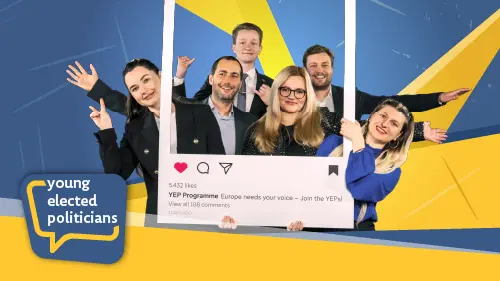
On 8 July 2026, around 35 members of the Young Elected Politicians Programme (YEPs) of the European Committee of the Regions (CoR) gathered online for the webinar on “Delivering Intergenerational Fairness at the Local and Regional Level.” The event brought together Tine Radinja (SI/Greens+PRO), Mayor of Škofja Loka and CoR Rapporteur on Intergenerational Fairness, Erica Bol from the European Commission's Joint Research Centre (JRC), and five YEP speakers to discuss how local and regional authorities can ensure that today's decisions contribute to a fairer future for generations to come.
The webinar built on the CoR's ongoing work on intergenerational fairness, including a consultation held in March 2025 between Mr. Radinja and eight YEPs. It also reflected the shared understanding across the CoR's political groups that intergenerational fairness is ultimately measured by what today's policymakers leave behind for future generations: opportunity, sustainability and hope.
Opening the webinar, Mr Radinja stressed that intergenerational fairness begins in Europe's cities, towns and regions. He emphasised that foresight and evidence-based policymaking can help local and regional authorities better anticipate future challenges and take decisions that serve not only today's citizens, but also future generations.
Building on this perspective, Erica Bol, expert at the EU Policy Lab (JRC), presented the European Commission's work and the practical tools being developed to support policymakers integrate long-term thinking into public decision-making. She encouraged participants to view intergenerational fairness not as a single policy objective, but as a continuous cultural shift that requires the active involvement of all generations.
Intergenerational Fairness in Practice: Experiences from the YEPs
Five YEPs showcased how intergenerational fairness is already being translated into action across Europe's communities. Drawing on experiences from Austria, Portugal, Belgium and Germany, they shared practical examples of youth participation, intergenerational dialogue and future-oriented policymaking.
Flora Schmudermayer (AT/EPP), Local Councillor in Tulln, Austria, highlighted participatory urban planning processes that give young people a stronger voice in shaping their communities. Tiago Ricardo (PT/PES), Citizens' Representative in the Abrantes, Municipal Assembly, presented national and local initiatives promoting youth participation, housing and wellbeing, including Portugal's Intergenerational Justice Index. Jean-Louis Hanff (BE/Renew), City Councillor in Brussels, shared an intergenerational dialogue project bringing younger and older residents together to address the challenges of digitalisation. He also argued that public policies should routinely assess who benefits from change, who bears the costs and who risks being left behind. Jolien Wittemans (BE/EA), City Councillor in Tremelo, Belgium, focused on the specific difficulties of engaging young people in rural areas and the need for flexible, youth-friendly participation methods. Finally, Caroline van Monsjou (DE/Greens+PRO), District and Local Councillor in Baden-Württemberg, Germany, shared examples of participatory local democracy and described how her region uses sustainability and future-generation impact checks when evaluating public investments and infrastructure projects.
The discussion that followed looked beyond youth participation alone and explored how local and regional leaders can better integrate the interests of future generations into policymaking. Participants exchanged views on citizenship education, sustainability assessments, foresight tools, and the role of schools in fostering civic engagement. A recurring theme throughout the webinar was the need to embed intergenerational fairness as a guiding principle across all policy areas, rather than treating it as a separate policy field.
In his closing remarks, Tine Radinja underlined that intergenerational fairness requires policymakers to look beyond immediate needs and "future-proof" today's decisions. He stressed that cities, towns and rural areas must all be part of this conversation and that empowering young people remains essential to building fair, resilient and sustainable communities for generations to come.
Useful information
EC Information Page: EU Strategy on Intergenerational Fairness
This news item was written in framework of the CoR Young Elected Politician Programme.
Contact
Eva Tomara
Email: yep-programme@cor.europa.eu
Tel: +3222822125
Slovenia
Member
Mayor of the Municipality of Škofja Loka