Angela Machado
Angela.Machado@cor.europa.eu

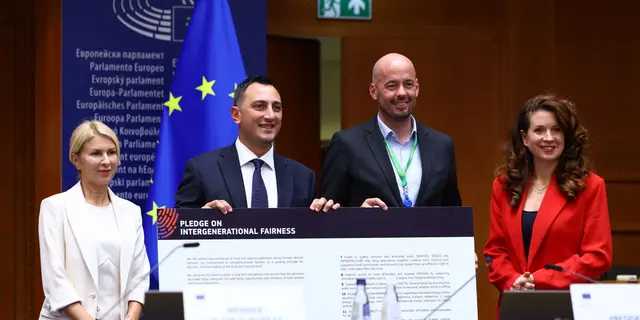
Local and regional leaders called on 7 May for fair, future-proof policies to safeguard the rights of young people and future generations and shield them from the consequences of unsustainable, short-sighted policies, during a meeting of the commission for Social Policy, Education, Employment, Research and Culture (SEDEC) on 7 May. They also discussed the mid-term review of the Social Economy Action Plan and the 40th anniversary of the European Capitals of Culture.
Intergenerational fairness
In a draft opinion adopted on 7 May, regions and cities stressed that intergenerational justice is vital for sustainable and resilient societies. They underlined that current policies must consider long-term impacts, especially in the areas of the environment, employment, housing, social protection, public spending and governance. SEDEC members acknowledged the injustice that arises when one group benefits from policies and measures while another shoulders the consequences, especially across generations, and therefore urged the EU to embed intergenerational fairness and youth perspective in all areas of policy-making.
CoR members emphasised that local and regional authorities play a vital role in implementing forward-looking policies and fostering intergenerational solidarity. They welcomed the European Commission initiative for a comprehensive European strategy on intergenerational fairness which should become a “moral compass” for better policy making. They highlighted the role of culture, environmental sustainability, intergenerational mobility, and a fair distribution of wealth in establishing a framework for solidarity between generations . In addition, they advocated for intergenerational projects that foster mutual learning, solidarity and civic involvement. Members also underlined the political responsibility of both the EU and local authorities to ensure that today’s decisions do not become a burden for future generations.
Rapporteur Tine Radinja (SI/Greens), Mayor of the Municipality of Škofja Loka, said: "The needs of one generation cannot come at the cost of the next. Intergenerational fairness calls us to act with empathy, foresight, and responsibility — bridging young, current, and future generations through shared values and inclusive policies. By following the principles of Intergenerational Fairness, we shape a sustainable legacy that honours every generation’s right to thrive."
Mid-term review of the Social Economy Action Plan
SEDEC members debated the 2025 mid-term results of the Social Economy Action Plan 2021-2030 (SEAP), adopted by the European Commission in 2021. The plan outlined 60 measures to boost access to finance and markets, job creation and support the green and digital transitions within the social economy (of co-operatives, associations, foundations, mutuals, social enterprises).
Regions and cities stressed the value-added of the SEAP for a more inclusive and more sustainable Europe. They voiced concerns, however, about persisting challenges to its effective implementation, such as limited access to finance, and the need for capacity building and wider recognition of the sector. Members called for enhanced and sustained support measures and simplified access to resources, including improved public and private financing mechanisms for the social economy.
European Capital of Culture: state of play and future perspectives
On the occasion of the 40th anniversary of the European Capitals of Culture (ECoC) Action, initiative, marked on 4 April in Chemnitz, CoR members discussed the future of European Capitals of Culture initiative. Local and regional leaders highlighted the ECoC’s vital role in promoting cultural development and cohesion and shared their own successful experiences of the initiative. They stated that preserving Europe's cultural heritage is a strategic investment in identity and community resilience. Looking ahead, future ECoC editions should continue to celebrate the rich diversity and shared spirit of European cultures, with a particular focus on empowering smaller cities and regions.
Also during the meeting:
SEDEC Members held a first exchange of views on the following opinions:
To re-watch the meeting, click here. The next SEDEC meeting will take place on 17 June 2025.
Background
Angela.Machado@cor.europa.eu
Romania

Member
Mayor of Cluj-Napoca Municipality, Cluj County


Sweden
Member
Member of Municipal Council, Lidköping Municipality


Slovenia
Member
Mayor of the Municipality of Škofja Loka

Belgium
Alternate
Member of Berchem-Sainte-Agathe Municipal Council
Local and regional leaders agreed that Europe needs to step up intergenerational fairness and stressed that the EU's cultural strategy needs to serve local communities.
At a conference in Slovakia, SEDEC members discussed how to bridge the innovation gap between metropolitan, rural and cross-border regions.

The European Committee of the Regions (CoR) and the European Commission signed a renewed Joint Action Plan during the meeting of the CoR’s Social Policy, Education, Employment, Research and Culture …
