Ângela Machado
angela.machado@cor.europa.eu

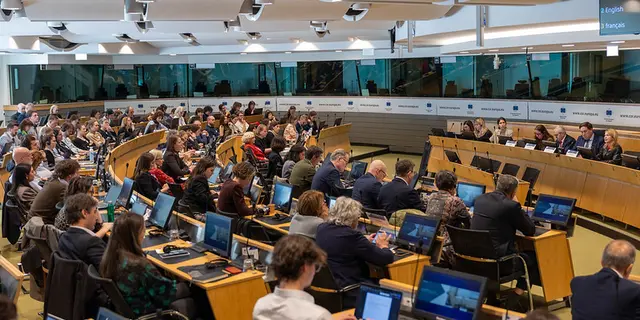
Strengthening Europe's competitiveness was at the centre of a meeting of the commission for Social Policy, Education, Employment, Research and Culture (SEDEC) on 30 September. Local and regional leaders debated the EU Start-up and Scale-up Strategy, the forthcoming Quality Jobs Roadmap, the 'Zero Long-term Unemployment' pilot project, the European Heritage Label and the 2025 European Semester Spring Package.
EU Start-up and Scale-up Strategy
Members exchanged views on a working document on the EU Start-up and Scale-up Strategy. They welcomed the initiative launched by the European Commission in May 2025 that aims to strengthen Europe's competitiveness. They emphasised the key role of local and regional authorities in the success of the strategy, as the level of governance closest to entrepreneurs, and urged for better access to funding, talent, markets, collaborative networks and infrastructure to strengthen regional ecosystems, reduce disparities and ensure balanced, innovation-driven growth across Europe.
Rapporteur Jozef Viskupič (SK/Renew Europe), Chairman of the Trnava Self-Governing Region, said: “The emphasis on start-up and scale-up support is welcome as a tool for high-tech industrial competitiveness, but the role of regional innovation ecosystems in bringing partners together and combining funds should be better recognised. The CoR aims to contribute to future Commission proposals announced in the Start-up Strategy, especially the Innovation Act, and remains available to the Danish and Cypriot presidencies for constructive dialogue.”
Quality Jobs Roadmap
During the meeting, SEDEC members welcomed and discussed the Quality Jobs Roadmap, which is expected to be launched by the European Commission in the fourth quarter of 2025. They welcomed the initiative, which aims to foster well-functioning labour markets, promote quality jobs and fair working conditions, boost productivity and innovation, and address labour shortages to enhance the EU's competitiveness. However, they underlined that local and regional authorities should not only be implementers but true architects of this transformation and stressed that investing in skills is crucial. They highlighted that this initiative should present a clear vision for the future of European citizens, guaranteeing quality jobs and reducing uncertainty.
Debate on "Zero long-term unemployment” pilot project
Following the official launch by the European Commission of the Zero long-term unemployment pilot project in April 2024, which came as a response to a call set out in CoR's opinion on zero long-term unemployment, local and regional leaders, high-level representatives of the European Commission and project stakeholders discussed, during the SEDEC meeting, the first steps and initial results, and the opportunities and challenges of the implementation of the nine successful projects of the pilot, which involved the active participation of local actors. Members stressed the key role of local and regional authorities in addressing needs on the ground and highlighted the specific challenges of unemployment in rural areas. They also underlined that ensuring sustainable financing mechanisms is vital so that these projects, which put citizens and their needs at the centre, can continue to combat long-term unemployment.
European Heritage Label (EHL) initiative
Local and regional leaders held a debate on the European Heritage Label (EHL), which has been already awarded to 67 sites, reaffirming the CoR's strong support to the initiative as a driver of identity and European integration. They pointed out that the involvement of local communities remains a challenge and stressed that local and regional authorities (LRAs) are well placed to support the implementation of the EHL thanks to their experience with cultural events and their proximity to citizens. Members also emphasised the importance of the initiative for regional identity, European integration and sustainable development.
European Semester Spring Package: Boosting research and innovation for competitiveness
SEDEC members also discussed the assessment of the European Semester 2025 Spring Package, which highlights the importance of research and innovation (R&I) as a driver of EU competitiveness and underlines the key role of regions and cities in fostering strong local innovation ecosystems, vital for a sustainable EU economic growth, and successful green and digital transitions. They stressed the need for better coordination across EU, national, and regional levels to align policies and funding instruments and underlined the role of the European Committee of the Regions in promoting territorial cohesion, stakeholder engagement, and best practices.
Also during the meeting SEDEC members appointed four new rapporteurs:
angela.machado@cor.europa.eu
France

Member
Vice-President of the Region of Centre-Val de Loire


Romania

Member
Vice-president of the Harghita County Council



Germany

Member
State Secretary, Rhineland Palatinate State Government


To mark the 100 years of Bauhaus movement in Dessau, the European Committee of the Regions (CoR), together with the European Commission’s Joint Research Centre and the Region of Saxony-Anhalt, in…
Young people’s voices were at the centre of a debate on the future of EU youth policy, cyber-bullying and culture with Glenn Micallef, European Commissioner for Intergenerational Fairness, Youth,…

Local and regional leaders debated on 28 November how the EU long-term budget proposals for 2028–2034 will affect Europe's policies in research and innovation, education and mobility…