Tā kā gaisa trošu sirēnas skan pāri valstīm, kas robežojas ar Ukrainu, un sakrīt ar jaunākajiem Krievijas uzbrukumiem netālu no Polijas robežas, to reģionu situācija un statuss, kuriem ir kopīga…
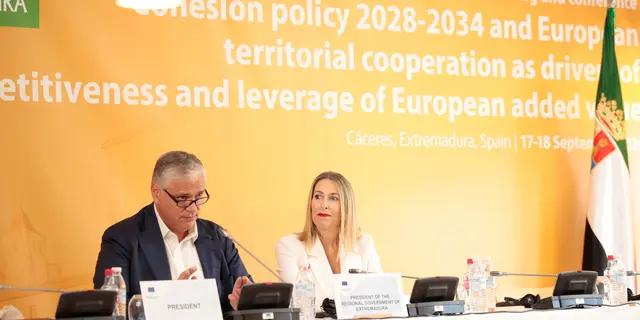

Bottom-up cooperation with EU neighbouring countries, whether at land or sea borders, helps promoting cohesion and creating mutual trust, which is an essential catalyst for democracy and peace. On the eve of a crucial vote of the European Parliament's committee on Regional Development on the topic, local and regional leaders urge EU decision makers to increase the funding and the efficiency of cross-border programmes. Recommendations are included in an opinion drafted by the President of the Regional Assembly of Corsica, Marie-Antoinette Maupertuis.
The Russian invasion of Ukraine had significant consequences on cross-border cooperation with neighbouring countries. Interreg programmes with Russia and Belarus were suspended and resources redirected towards Ukraine and Moldova, both candidate countries to join the European Union. With an opinion adopted by unanimity at the Plenary session on 29 November, voted after a debate with the European Parliament's rapporteur on the topic Daniel Buda (RO/EPP), the European Committee of the Regions (CoR) asks to set-up a mechanism to compensate EU border regions affected by the drop in access to funding due to the conflict.
Regional and local leaders underline the crucial role that cross-border cooperation can play in achieving sustainable development, promoting mutual understanding (preventing conflicts) and joint projects across external borders. Regions can also be key in supporting neighbouring local authorities with capacity building, sharing best practices, infrastructure development and in promoting economic and cultural ties. For these reasons, the Committee stresses the urgent need to support local and regional authorities in the reconstruction of Ukraine while continuing to support neighbouring regions and encouraging increased cooperation.
In light of the major challenges facing the Mediterranean region, such as armed conflict, migration, climate change and political instability, the Committee has also reiterated the need for more cooperation with neighbouring local authorities in order to ensure lasting stability and sustainable development.
Simplification and maritime borders
Cities and regions also call on the European Commission to simplify the existing mechanism for territorial cooperation, such as macroregions and EGTCs (European Grouping of Territorial Cooperation), and stress the need for maritime cross-border cooperation to be better structured, given that many of the EU's neighbouring countries are located in the Mediterranean basin. For many islands, territorial cooperation in general – and cross-border cooperation in particular – is vital for maintaining ties with the EU mainland and with their neighbours.
Quote
The rapporteur Marie-Antoinette Maupertuis (FR/EA), President of the Regional Assembly of Corsica, said: "Europe is facing a series of simultaneous crises, ranging from the war in Ukraine provoked by Russia to the conflict in the Middle East, the migratory crisis in the Mediterranean and climate change. In this critical context, it is imperative to strengthen land and maritime cross-border cooperation to promote peace, cohesion and prosperity, by building trust and developing joint projects between the regions and local authorities of the EU and its neighbours."
Next steps
The opinion will now be published on the Official Journal of the European Union.
Ms Maupertuis will illustrate the main messages of the opinion to the members of the Assembly of Corsica during the next meeting, in December.
On 30 November, the REGI committee of the European Parliament will vote on the draft report "Current and future challenges regarding cross-border cooperation with neighbouring countries". The vote at the Plenary session is actually scheduled for January 2024.
More information
In a separate opinion on the future of Cohesion Policy post-2027 (co-rapporteurs Cordeiro-Boc), adopted as well on the 29 November at the Plenary session, the CoR asks to increase the European Territorial Cooperation budget to no less than 8% of the total amount of Cohesion Policy.
On 20 September, the CoR rapporteur Maupertuis presented the work on her opinion to the members of the REGI committee of the European Parliament. Re-watch the debate.
Pictures from the Plenary of the CoR
Contact:
Matteo Miglietta
Tel: +32 470 89 53 82
matteo.miglietta@cor.europa.eu
Tā kā gaisa trošu sirēnas skan pāri valstīm, kas robežojas ar Ukrainu, un sakrīt ar jaunākajiem Krievijas uzbrukumiem netālu no Polijas robežas, to reģionu situācija un statuss, kuriem ir kopīga…
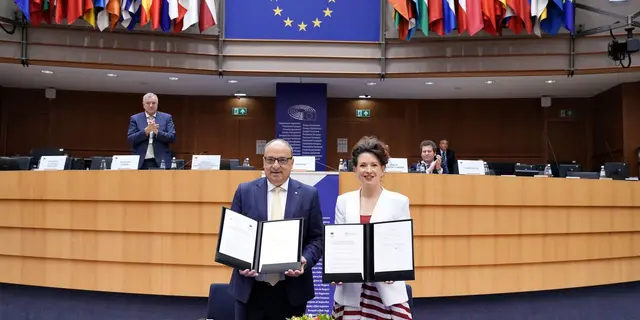
Eiropas Reģionu komiteja (RK) un Šveices kantonu valdību konference (CCG) 2026. gada 2. jūlijā RK plenārsesijā parakstīja saprašanās memorandu.
Vietējās un reģionālās pašvaldības ir oficiāli jāiesaista turpmākajā ES iekšējās drošības instrumentā 2028.–2034. gadam. Tas ir galvenais vēstījums atzinumā “Savienības atbalsts iekšējai drošībai…