Lithuania

Arnoldas ABRAMAVIČIUS
Członkini/członek
Councillor of the local government council, Zarasai District Municipality Council

EPP (European People's Party)

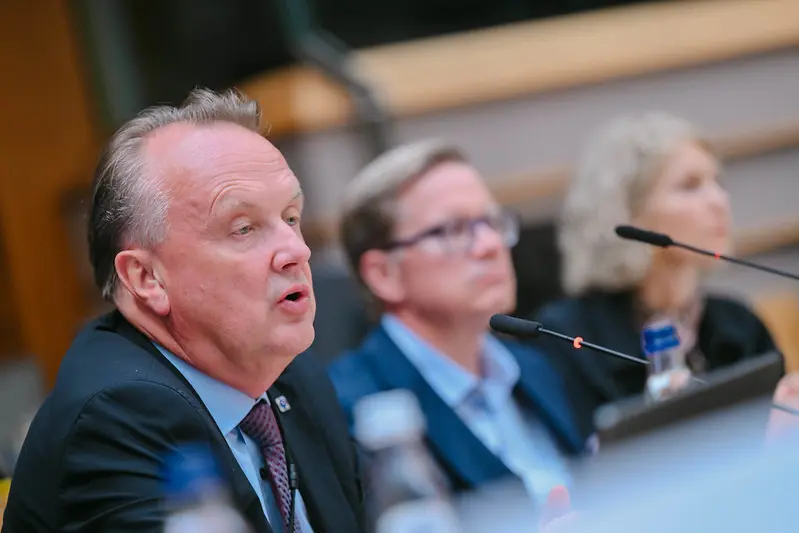
Migration should not be treated as a secondary issue inside broad national plans envisaged by EU reforms, regions and cities say.
Funding for the European Union's new approach to migration, integration and asylum needs to focus on the needs of regions and communities in which new arrivals settle, the European Committee of the Regions (CoR) said on 1 July.
In its formal position on the European Union's support for asylum, migration and integration management in 2028-2034, the CoR said that the European Union must guarantee a clear role for local and regional authorities in the planning, management, monitoring and evaluation of EU-funded plans.
The opinion, which was drafted by Arnoldas Abramavičius (LT/EPP), member of Zarasai District Municipality Council, places particular emphasis on the reception and integration of asylum-seekers and migrants, on the grounds that these are the areas of policy and public services where regional and local authorities play the biggest role.
Responsibilities that typically fall to local and regional authorities include support for housing, health-care, education, language-learning, training, and employment. The opinion also notes the increased efforts needed to counter disinformation, to cooperate with countries from which migrants originate and through which they travel en route to the EU, and to deal with the 'the weaponisation of migration' by state or non-state actors in third countries on the EU’s eastern borders.
The CoR's opinion is a follow-up to policies set out in the Pact on Migration and Asylum, which came into force in June 2024, and to funding plans set out in the proposed Multiannual Financial Framework for 2028-2034.
"The success of the Pact on Migration and Asylum will be measured not here in Brussels, but in our towns, neighbourhoods, and schools - where integration either succeeds or fails," Mr Abramavičius said.
The CoR's opinion, adopted at the assembly's plenary session on 1-2 July, emphasised that funding needs to be predictable and accessible. It also raised concerns that funds might not be targeted adequately and warned that long-term objectives could be undermined by an overly rigid performance-based approach, which would place additional burdens on local and regional authorities with limited administrative capacity.
The opinion specifically mentions rural, mountainous, minority-populated and border areas, as well as coastal, insular, outermost and demographically affected regions. Those are territories that face disproportionate migratory pressures and security challenges, and are therefore in greater need of targeted support for their reception and integration policies. They may also, as the opinion notes, lack the resources and technical and administrative capacities that rich urban areas have. The CoR consequently calls for dedicated technical assistance, arguing that capacity-building support should be recognised as an essential element of a performance-based approach.
The opinion calls for dedicated funding targets and specific provisions for asylum, migration and integration in the EU's disbursement of funds to its Member States. It stresses that financial governance should be in line with the EU's established partnership principle, its multilevel governance approach, and a place-based approach.
The calls for transparent financial governance and predictable funding tailored to local needs as well as the emphasis on established EU governance principles reflect wider concerns that the regions and cities have expressed about a defining feature of reforms proposed by the European Commission: the pooling of many major items of the EU budget, ranging from agriculture and regional development to migration, into a single fund, to be distributed to Member States on conditions set out in National and Regional Partnership Plans (NRPPs).
This shift away from shared management of funds by European, national and sub-national authorities has generated fears that regions and cities could be marginalised and transformed from partners in policy-making into mere implementers. In a series of opinions on the 2028-2034 Multiannual Financial Framework, the CoR has sought to ensure that there is systematic, structured and effective involvement of regions and cities in the design, programming, implementation and monitoring of NRPPs.
Quote:
Arnoldas Abramavičius (LT/EPP), CoR rapporteur and member of Zarasai District Municipality Council: "With the Pact on Migration and Asylum, regions, cities and member states have taken a serious commitment to managing migration adequately. Our capacity to do this will depend on the organisation of the funding in the Multiannual Financial Framework for 2028-34. Regions and cities will need to keep delivering one reception and integration and therefore we need predictable funding and targeted capacity-building measures. I call for dedicated provisions in the NRPPs for asylum, migration and integration, which consider the needs of regional and local authorities, following the principles of multi-level governance and partnership."
More information:
Contact:
Andrew Gardner
Tel: +32473 843 981
andrew.gardner@cor.europa.eu
Lithuania
Członkini/członek
Councillor of the local government council, Zarasai District Municipality Council