Pe măsură ce sirenele de raid aerian răsună în țările care se învecinează cu Ucraina și coincid cu cele mai recente atacuri ruse din apropierea frontierei poloneze, situația și statutul regiunilor…

The untapped potential of so-called 'functional areas', which bring together different neighbouring administrations to address common challenges, was the focus of a seminar held on 12 July on the shores of Lake Balaton, in Hungary. Discussions among EU decision makers and experts explored how functional areas could further boost territorial development in Europe within Cohesion Policy.
Lake Balaton in Hungary is an example of how an approach of functional areas can support territorial development. Like many European lakes, Lake Balaton is exposed to environmental changes as well as economic issues due to an over-dependence on tourism, and it is spread over several municipalities and regions. Through the Lake Balaton Development Council, development strategies and the use of funds are coordinated across administrative borders to best address challenges. The Lake Balaton region was among 12 functional areas selected by the European Commission and the World Bank in 2022 for a pilot project to receive technical support for green transition and sustainable development.
A seminar organised by the commission for Territorial Cohesion Policy and EU Budget (COTER) of the European Committee of the Regions (CoR), together with the Hungarian City of Balatonfüred, on 12 July, gathered on the shores of Lake Balaton local, regional and national leaders, as well as representatives of the EU institutions and experts, to explore how functional areas and other territorial tools could be enhanced within Cohesion Policy.
Participants in the seminar agreed on the need for a strong Cohesion Policy post-2027, with a place-based approach and the principles of partnership and multi-level governance, as well as strengthened support to functional areas. In particular, non-urban functional areas should be given more attention.
Quotes
Emil Boc (RO/EPP), Chair of the COTER commission and Major of Cluj-Napoca: "Functional Areas and Cohesion Policy are working on the ground. We must continue to learn from and improve on the current experience. For the future, we need to keep a strong Cohesion Policy for all regions, with its golden rules such as the place-based approach, multi-level governance and partnership. Beyond Cohesion Policy, I believe that other EU policies could also benefit from a functional area approach."
Cluj Metropolitan Area is also among the European 12 functional areas selected in 2022.
Tibor Navracsics, Minister of Public Administration and Regional Development of Hungary: "Cohesion Policy should remain one of the most important policies of the European Union, since it ensures the future competitiveness of the European Union. Even during the most severe economic crisis, in the last three years, the level of cohesion has further strengthened in the European Union and the less developed regions have continued catching up. Achieving these would have been impossible without the support of the Cohesion Policy."
István Bóka (HU/ECR), Mayor of Balatonfüred and Chairman of the Lake Balaton Development Council: "Not only urban areas can be functional areas, but also natural areas, such as lake areas, where not a city is located in the centre, but a big lake, like the Lake Balaton. Supporting and developing functional areas, with flexible structures applicable to specific areas with specific characteristics, should be important element of the Cohesion Policy.."
Additional material
Presentations and material shown during the event can be consulted here.
Contact
COTER secretariat:
COTER@cor.europa.eu
Pe măsură ce sirenele de raid aerian răsună în țările care se învecinează cu Ucraina și coincid cu cele mai recente atacuri ruse din apropierea frontierei poloneze, situația și statutul regiunilor…
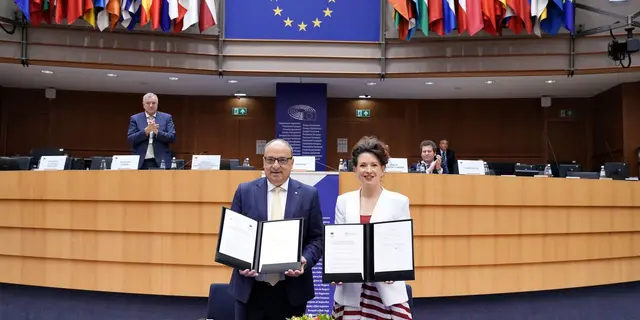
Comitetul European al Regiunilor (CoR) și Conferința guvernelor cantonale din Elveția (CCG) au semnat un memorandum de înțelegere la 2 iulie 2026, în cadrul sesiunii plenare a CoR.
Autoritățile locale și regionale trebuie să fie implicate oficial în viitorul instrument de securitate internă al UE pentru perioada 2028-2034. Acesta este mesajul central al avizului „Sprijinul…