Portugal
Vasco ALVES CORDEIRO
Član/Članica
Member of the Regional Assembly of the Azores

PES (Party of European Socialists)


The meeting of the national representation in the European Committee of the Regions in Logroño culminated in the ‘La Rioja Declaration’, which proclaims the importance of having ‘a model of cohesion policy that reflects the priorities of the regions’.
The Government of La Rioja has renewed the commitment of the Community to European construction during the meeting of the Spanish Delegation to the European Committee of the Regions (CoR), organized today, November 29, by the Regional Executive at the Institutional Winery of La Grajera, on the occasion of the 30th anniversary of this EU consultative body representing local and regional authorities. The meeting concluded with the reading of the ‘La Rioja Declaration’, which proclaims the importance of having a ‘cohesion policy model that reflects the priorities of the regions’ in the future.
La Rioja, which holds the head of the Spanish delegation to the European Committee of the Regions until the end of the current term of office (February 2025), on Friday brought together representatives of European institutions and of the CoR's member autonomous communities and municipalities, as well as various experts on European affairs.
During the opening of the meeting, the Minister of Finance, Public Governance, Digital Society and Spokesperson, Alfonso Domínguez, stressed that the Government of La Rioja will continue to contribute to the European construction and stressed the support that the EU represents for the economic and social development of the community, giving as an example the La Grajera research complex, "funded at 50% by cohesion funds".
For his part, the Director-General of the Autonomous and Local Legal Regime of the Ministry of Territorial Policy and Democratic Memory, Gonzalo Díaz Millán, explained that ‘the EU cannot be understood without the voice of the territories represented in the CoR’ and stressed ‘the importance of Cohesion Policy, which has generated so much well-being and territorial development’.
The mayor of Logroño, Conrado Escobar, has claimed that “municipalities have a stronger and more demanding voice in Europe”, while the president of the CoR, Vasco Alves Cordeiro, by videoconference, has congratulated the Spanish regions for their contribution to the European project and the implementation of “good policies that take into account territorial realities”.
The day featured two round tables discussing European policies and their impact on local and regional authorities. Both forums have also served to reflect on the present and future of the European Committee of the Regions, exchanging examples of good practices of Spanish participation in the CoR.
The meeting ended with the reading of the ‘La Rioja Declaration’ by the Director-General for Funds and Relations with the EU, Jesús Ángel Garrido. In this document, the Spanish CoR members underline the Committee's role in the European decision-making process.
The text also affects the commitment of the Spanish Delegation to the European Committee of the Regions during these three decades: "The members of the Spanish Delegation to the CoR have been an active part of this process and want to contribute to it in the future, highlighting their commitment to European integration and to the design of Community policies that respect economic cohesion, but above all social and territorial cohesion".
“A just transition for all”
In view of the CoR’s next term of office starting in 2025, the ‘La Rioja Declaration’ makes a series of recommendations on the areas on which the Committee should focus in the future, in particular ‘on all matters relating to green, digital, demographic, social, cohesion and competitiveness policies, within the framework of a just transition for all’.
In this regard, the text adopted in Logroño highlights the importance of having in the future "a model of cohesion policy designed and implemented on the basis of regionalised programmes, reflecting the priorities of the regions".
Finally, and in relation to the next European budget, the members of the Spanish Delegation to the CoR request that the voice of the regions be taken into account in the definition of the future Multiannual Financial Framework: “Regions and municipalities, as administrations closest to citizens, can contribute to the collection and analysis of concrete data relating to the needs and priorities of their territories and the citizens who live there”.
Portugal
Član/Članica
Member of the Regional Assembly of the Azores
Predsednik Kata Tüttő je v imenu Evropskega odbora regij 25. maja v samostanu San Jerónimo de Yuste (Ekstremadura, Španija) od svojega veličanstva španskega kralja Felipeja VI. prejel evropsko…
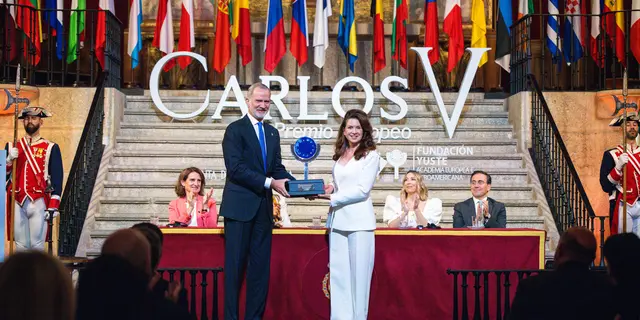
Na dan Evrope praznujemo izjemen človeški dosežek: Sposobnost milijonov ljudi, kultur, jezikov in zgodovine, da živijo skupaj v miru.

Evropski odbor regij (OR) bo prejel evropsko nagrado Carlos V, ki jo podeljuje Fundacija Evropske in Ibersko-ameriške akademije v Yusteju, ki priznava njeno bistveno vlogo pri zagotavljanju…
