Theresa Sostmann
Theresa.Sostmann@cor.europa.eu

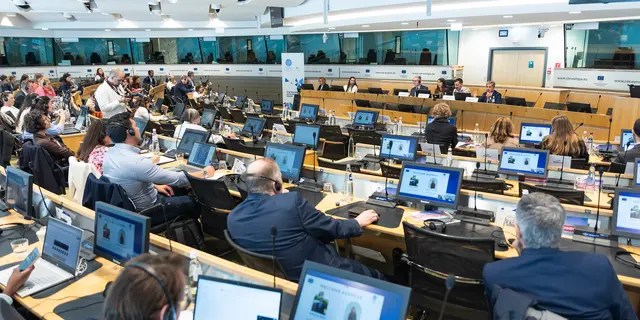
Cross-border cooperation is one of the cornerstones for achieving cohesion and resilience across the EU, to ensure competitiveness and strengthen the single market. While progress has been made in facilitating cross-border interactions in recent years, many obstacles remain. In this context, the European Cross-Border Platform (ECBP) held its annual meeting in Gorizia, Italy, on 13 and 14 November, focusing on new political developments, practical experiences, and innovative policy solutions to strengthen cross-border cooperation.
The meeting was co-organised by the European Committee of the Regions (CoR) and the Autonomous Region of Friuli Venezia Giulia upon the invitation of its President and member of the CoR Massimiliano Fedriga (IT/ECR), and brought together more than 250 representatives of European institutions, regional and local authorities, cross-border structures and networks with the aim of overcoming the remaining obstacles faced by citizens and administrations in border regions.
During the event, participants stressed that citizens, businesses and administrations in border regions continue to encounter difficulties in their daily lives, whether it be finding a job, accessing healthcare, everyday commuting or overcoming administrative problems. They highlighted that the context for cross-border cooperation has changed significantly in recent years due to the war in Ukraine, Brexit and the UK’s withdrawal from Interreg and the reintroduction of border checks.
Furthermore, the discussions in Gorizia explored practical improvements for citizens, businesses and administrations living and working across borders and how border regions can become more resilient, better manage crises and contribute to EU enlargement by fostering cooperation and stability in Europe’s neighbourhood. Participants underlined that successful and future-proof cross-border solutions are built on multi-level governance, the partnership principle and the involvement of young people.
Participants further emphasised that the Interreg programme should be strong, flexible and simple to the use for beneficiaries, and that to fulfil its role, cross-border cooperation needs continuity and predictability. They highlighted the importance of trust and political will on both sides of the border to make cooperation work, and that small projects have an important role to play in building the trust. Small project funds, simplified cost options and people-to-people projects therefore need to remain features of Interreg 2028-2034. Beyond Interreg, the BRIDGEforEU regulation and the European Groupings of Territorial Cooperation (EGTC) were highlighted as important tools to help overcome cross-border obstacles.
The second day was dedicated to the ECBP’s EGTC Working Group, which focused on the added value of the EGTC tool and its future perspectives. Participants shared experiences from various cooperation structures, highlighting how the EGTC framework supports, for example, education, innovation, and public services across borders.
Quotes
Pavel Branda (CZ/ECR), Member of the Local Assembly of the Municipality of Rádlo and President of the ECBP: “Today's meeting underlines, once more, the importance of removing cross-border obstacles of all kinds: local communities are asking for renewed efforts in this direction, to make cross-border life better for both citizens and companies. New challenges have also emerged due to the recent geopolitical challenges, from the war in Ukraine to illegal migration, with significant impacts on border regions. We need a stronger, simpler and more flexible Interreg, to make our border regions more resilient, also allowing them to better contribute to the EU’s growth and competitiveness.”
Raffaele Fitto, Executive Vice-President of the European Commission for Cohesion and Reforms said in a video message: “We have seen great progress in removing cross-border obstacles, yet many challenges remain, from technical to administrative barriers. This meeting is an excellent opportunity to discuss how we can best continue to remove obstacles, and make cross-border life simpler, better and more dynamic.”
More information
The European Cross-Border Platform (ECBP) was established in 2024 by the European Committee of the Regions as the successor to the EGTC Platform. It brings together all key actors in cross-border cooperation, including local and regional authorities, EGTCs, Euroregions, and cross-border networks, to exchange knowledge, share experiences, and promote effective European territorial cooperation.
Contact
Theresa Sostmann
Tell: +32475999415
Theresa.Sostmann@cor.europa.eu
Theresa.Sostmann@cor.europa.eu
Czechia
Member
Member of the Local Assembly of the Municipality of Rádlo


The European Committee of the Regions (CoR) and the European Olympic Committees (EOC) have urged EU co-legislators to embed sport across all Multiannual Financial Framework (MFF) 2028–2034 funding…
Improving the current proposal for the EU's long-term budget 2028-34 through genuine involvement of regions and cities in the modernisation and simplification of Cohesion Policy. This is the aim…

The European Committee of the Regions (CoR) has published the sixth edition of the EU Annual Report on the State of Regions and Cities, which was presented by President Kata Tüttő on 13 October at…