Romania

Emil BOC
Membre
Mayor of Cluj-Napoca Municipality, Cluj County

EPP (European People's Party)


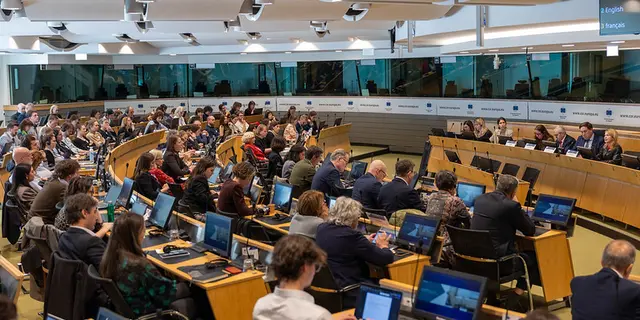
The European Committee of the Regions, in partnership with the European Commission, DG Employment, Social Affairs and Inclusion (DG EMPL), held an event, on 25 April, as part of the European Year of Skills, on strengthening regional and urban skills in Europe to boost sustainable growth and social cohesion.
At the event, entitled "Investing in skills in Europe's regions and cities", local leaders and key stakeholders discussed the crucial role of skills development, also through upskilling and reskilling, in strengthening the socio-economic fabric of Europe's regions and cities.
The panels featured the President of the European Committee of the Regions (CoR), Vasco Alves Cordeiro (video), Tanya Hristova (BG/EPP), mayor of Gabrovo and chair of the CoR's SEDEC Commission, Dragoş Pîslaru, member of the European Parliament and chair of the Parliament's Committee on Employment and Social Affairs, representatives of the European Commission and members of the Committee of the Regions
The conference focused on the critical need for adaptive skills development strategies in response to rapid technological and socio-economic changes, to improve labour-market adaptability and strengthen regional economic development. Key debates addressed the importance of upskilling and reskilling, skills intelligence tools, better vocational education and training strategies and the importance of public-private partnerships to support skills development at the local and regional level.
Vasco Alves Cordeiro, President of the European Committee of the Regions said: “The European Year of Skills offered us an unprecedented opportunity to look at our common challenges, discuss the needs and, above all, the strategies to tackle skill shortage and skills enhancement in our regions and cities. Recent studies indicate that 44% of Europeans lack basic digital skills, a gap that significantly hampers our collective digital transformation efforts. This reality brings to the forefront the urgent need for comprehensive digital education and training across all age groups and professional backgrounds. Together, we must continue to champion an ambitious and comprehensive approach to upskilling and reskilling across Europe."
Tanya Hristova (BG/EPP), chair of the SEDEC Commission, said: “Local and regional authorities are uniquely positioned to identify and respond to specific local skill needs and gaps, developing tailored responses and making their involvement essential for the successful implementation of the European Skills Agenda. Moreover, local and regional authorities play a pivotal role in mobilising local resources, coordinating with educational institutions, and fostering partnerships with private-sector stakeholders to support skills development. We can further work together and develop strategies that not only respond to current challenges but also create a resilient, skilled, and inclusive workforce that is the cornerstone of our collective prosperity."
Dragoş Pîslaru, member of the European Parliament and chair of its Committee on Employment and Social Affairs said:" The European Year of Skills provides the momentum to rethink our investments in skills and social investments in general. We must target the skills required for the net zero technology industries. Supporting local and regional initiatives and prioritizing upskilling and reskilling is the key for a prosperous future in a green economy. This is how we imagine a competitive and fair Europe."
To rewatch the event click here.
SEDEC Commission meeting 26 April 2024
During the SEDEC Commission meeting on 26 April, members exchanged views on three opinions:
These opinions are scheduled to be adopted by the SEDEC commission in June and in CoR plenary in October.
The meeting also included a presentation by the European Institute for Gender Equality (EIGE) on the annual indicators on the number of women in parliaments. In 2023, in political assemblies across the EU, women accounted for 36% of members at regional and 35% at local/municipal level. The share of women in the European Parliament has increased over the years, to 40% at present. National parliaments are lagging behind, with one in three deputies being a woman across the EU.
To rewatch the meeting, click here.
More information:
Event on "Investing in skills in Europe's regions and cities":
Romania
Membre
Mayor of Cluj-Napoca Municipality, Cluj County
Lors d’une conférence en Slovaquie, les membres de la commission SEDEC ont débattu de la manière de combler le fossé en matière d’innovation entre les régions métropolitaines, rurales et…

Le Comité européen des régions (CdR) et la Commission européenne ont signé un nouveau plan d’action conjoint lors de la réunion de la commission de la politique sociale, de l’éducation, de l’emploi,…

Pour marquer les 100 ans du mouvement Bauhaus à Dessau, le Comité européen des régions (CdR), en collaboration avec le Centre commun de recherche de la Commission européenne et la région de Saxe…