Matteo Miglietta
Matteo.Miglietta@cor.europa.eu
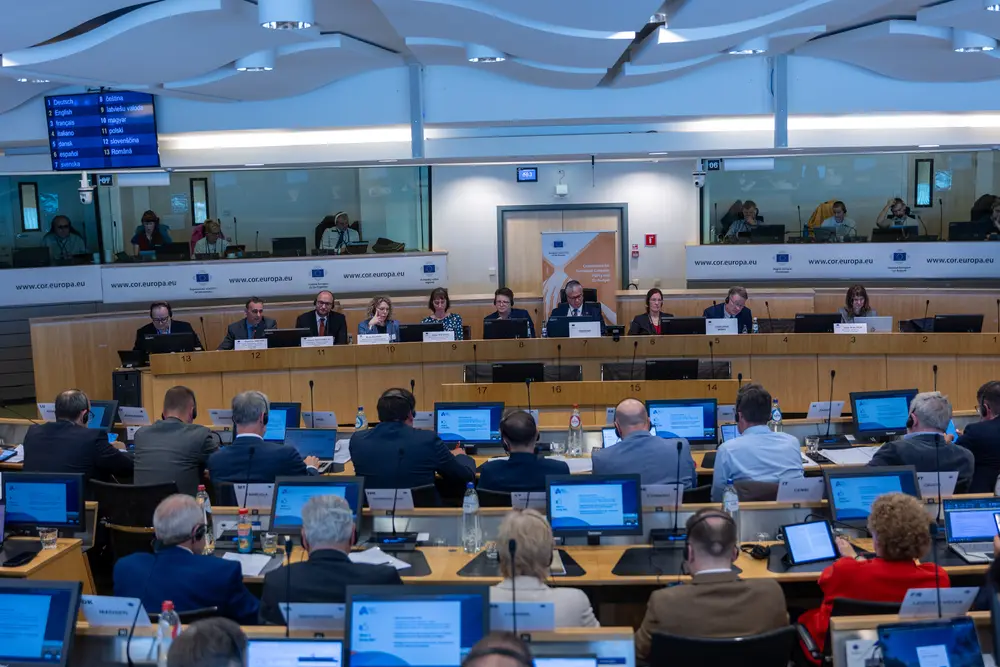
The state of play of the current Cohesion Policy programmes, as well as how to use this policy to better tackle disparities between urban and rural areas, were among the topics debated during the meeting of the Commission for Territorial Cohesion Policy and EU Budget (COTER) on 6 May. The territorial impacts of the green and digital transformation of the mobility system were also discussed during the meeting.
One month after the European Commission put forward its proposal for a Mid-term review of Cohesion funds programmes 2021-27, COTER members shared their views about the review, which would allow possibility regional investments to be re-directed towards priorities such as housing, water resilience and security. Managing authorities of cohesion programmes from France (Hauts-de-France region), Spain (Extremadura region), Greece (Attica region) and Croatia (the Ministry for Regional Development and EU Funds) joined local and regional leaders for a debate with a representative from the European Commission, The discussion highlighted that, despite initial delays, the absorption rate of cohesion funds is now accelerating quickly.
All speakers emphasised the importance of having a bottom-up approach as a means to promote economic and social convergence in every region. They opposed any attempt to centralise the governance of Cohesion Policy, both now and in the future. Many members therefore stressed the need to preserve Cohesion Policy’s key principles beyond 2027: partnership, shared management, multi-level governance, and a place-based approach.
Several speakers called for more flexible rules and less bureaucracy, particularly with regard to overlapping audit procedures, in order to make the use of resources more efficient. In this context, some managing authorities and COTER members noted that the European Commission’s proposal for the Mid-term Review was published after the official deadline for regions to submit their contribution according to existing rules (end of March). As a result, regions that had already submitted their contributions - built on the priorities and regulation already in force – may now be requested to review them in light of the new guidelines. This, they argued, would require extra bureaucratic work on authorities already struggling with limited human resources.
A specific focus on the urgency of tackling the urban-rural divide in Europe was at the heart of a debate with Denis Nesci (IT/ECR), Member of the European Parliament and rapporteur for ‘Strengthening rural areas in the EU through Cohesion Policy’ and Thibault Guignard (EPP/FR) rapporteur on the LEADER opinion which was recognised to be one of the success story of the cohesion policy. Citizens should have the right to live in rural areas with access to basic services such as health facilities and schools, local leaders said, and a reinforced Cohesion Policy is the best tool the European Union has at its disposal to achieve this objective.
Mobility poverty
During a debate on transport poverty, COTER members stressed that territorial disparities emerging from the EU’s green and digital mobility transition pose a growing challenge in regions, particularly in remote, rural, and cross-border regions, where public transport services are either inadequate or unaffordable. Participants stressed that local and regional authorities must play a leading role in planning and implementing the Social Climate Fund, emphasising that national plans should be developed through meaningful consultation with regional stakeholders to ensure that funding addresses real, on-the-ground needs and supports accessible, sustainable mobility for all. With a view to an upcoming legislative proposal on the decarbonisation of corporate fleets, members drew attention to difficulties in accessing zero-emission vehicles, limited local supply chains, and a lack of clarity about financial support available for fleet renewal. They called for stronger EU-level support, flexibility in implementation, and place-based approaches to ensure that no region is left behind in the mobility transition.
Quote
Vasco Alves Cordeiro (PT/PES), Chair of the COTER commission and member of the regional assembly of the Azores: “Today's debate laid bare an undeniable truth: the power of cohesion policy is rooted in the relentless engagement of our regional and local authorities. Members of the Committee of the Regions stood resolute, demanding that the long-term dimension of the cohesion policy remains. Only through such long-term approach can we achieve its effective implementation. However, the European Commission's newly proposed mid-term review appears to go the wrong course. New priorities necessitate new resources; this is not a time for mere adjustments but for bold action. Europe stands at a crossroads, and we must seize this moment to forge a path towards a truly united and resilient future.”
More information
Rewatch the meeting here.
On 14 and 15 May, the CoR plenary will vote on two urgent resolutions on the next long-term budget of the European Union and the Mid-term review of Cohesion Policy programmes 2021-27. Moreover, CoR members will vote on two opinions focusing on Cohesion Policy as an engine to achieve EU goals and reforms, and on how metropolitan regions and functional urban areas could continue to be drivers of sustainable investment in Europe. Press releases will be published in the dedicated section of the CoR website.
The Social Climate Fund is a funding programme designed to contribute to a socially fair transition in the Union’s effort to reach climate neutrality by 2050. It aims to address the social and economic impact of the climate transition on vulnerable groups. Notably, it aims to tackle energy and transport poverty and counterbalance the rising costs of fossil fuels resulting from extending the scheme for greenhouse gas emission trading to additional sectors in the European Union.
In February 2025, the European Committee of the Regions adopted an opinion proposing new implementation tools to boost local development in rural areas, drafted by the rapporteur Thibaut Guignard (FR/EPP), Mayor of the French city of Ploeuc-l’Hermitage. More information about the opinion.
Matteo.Miglietta@cor.europa.eu
Portugal

Medlem
Member of the Regional Assembly of the Azores


France

Medlem
Municipal Councillor of Ploeuc-l’Hermitage


De regionale ledere og Europa-Parlamentets medordfører for EU's flerårige finansielle ramme har udtrykt stærk modstand mod det seneste forslag til forhandlinger om det fremtidige EU-budget, den…

Europas førende bilregioner undertegnede i Bilbao den 27. maj en fælles politisk holdning til de to sager, der vil forme sektorens umiddelbare fremtid: loven om industrielle acceleratorer og…
Regioner og byer har opfordret til en stærkere rolle i den næste Connecting Europe-facilitet (2028-2034) for at sikre, at infrastrukturinvesteringer gennemføres effektivt og i højere grad tilpasses…
