Europski odbor regija (OR) pozvao je Europsku uniju (EU) da prepozna gradove i regije kao strateške partnere u svojoj vanjskoj politici, ističući da bi lokalne i regionalne vlasti trebale imati…
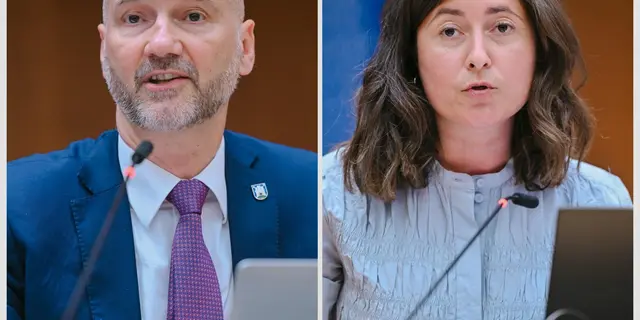

Mariupol's mayor highlights the reconstruction challenge for Ukraine, as European Committee of the Regions calls for more funding for long-term recovery.
The European Committee of the Regions has called on the European Union to be ready to provide additional long-term funding to support Ukraine's recovery from the war, in an opinion that backs the start of membership talks with Ukraine and Moldova.
The opinion on the enlargement reforms of Ukraine, Moldova, and Georgia, which was drafted by Antje Grotheer (DE/PES), President of Bremen City Parliament, was adopted on 17 April following a debate with Vadym Boychenko, mayor of Mariupol, a Ukrainian city, port and industrial centre of 450,000 people reduced to rubble by Russian armed forces in 2022.
Mayor Boychenko, who is now based elsewhere in Ukraine, urged the European Union to show unity with Ukraine, saying: “We have to show the world that we have united for the sake of the future Ukraine." He emphasised the need for preparations for reconstruction to start, and – invoking the experience of Warsaw, Wroclaw, Utrecht, Rotterdam, Le Havre and other cities re-built after the Second World War – urged to European cities to share their knowledge to help Ukraine's recovery. The administration of Mariupol, which has a long-standing cooperation with the Gdansk, among others, is working to support its displaced population and on a reconstruction project – Mariupol Reborn – that aims to transform Mariupol from a symbol of the war into a symbol of the revival of Ukraine.
The CoR's opinion, which also supported the EU's decision to grant Georgia the status of a candidate for EU membership, particularly emphasises the threat to Ukraine's recovery posed by its demographic challenges, saying that there is a need to "to prioritise investments in human capital, in particular education, vocational training, upskilling and support for youth, women, veterans and their families and internally displaced persons".
The war has worsened Ukraine's already negative demographic outlook, to the extent that a shortage of labour is highly likely to be one of the main challenges of post-war reconstruction, the CoR said. The likelihood is that over 20% of refugees – many of whom are working-age Ukrainians and their children – will not return after the war, the opinion suggests.
In December 2023, the EU pledged to provide Ukraine with €50 billion in non-military support by the end of 2027, to stabilise the country's finances and support is reconstruction and recovery. The CoR's opinion argues that this sum is unlikely to be sufficient and calls for the EU and its member states to commit to additional long-term financing for Ukraine, including to increase technical assistance for Ukraine's public administration. One pillar of the EU's support will focus on reconstruction at the local and regional level, with accompanying investment in public administration. The EU says that its support, via the Ukraine Facility, should encourage decentralisation and local development and give an important role to local authorities in Ukraine's recovery, reconstruction and modernisation.
The CoR's opinion praises the "tremendous efforts" of Moldova "on the path towards European integration in extremely hard circumstances", citing the challenges of hosting the "highest number per capita in Europe of refugees from Ukraine fleeing Russia's aggression, inflation, threats to energy supplies and hybrid attacks, such as information manipulation and cyberattacks". In addition to further efforts to curb corruption, Moldova should – the CoR suggests – focus on fiscal decentralisation and addressing a "shortage of qualified human resources" to improve the viability and capacity of local administrations and public-service delivery.
The CoR's assessment of progress in Georgia is less positive. While it describes Georgia's strategy for the decentralisation of power as "well-designed", it highlights the fragmentation of Georgia's public administration, deep political polarisation, lack of cross-party cooperation as major roadblocks to Georgia's EU integration, and the government's plan to pass a law that would result in some non-governmental organisations being labelled 'foreign agents'.
The CoR has been working with local and regional administrations in all three countries since 2010, through the Conference of Regional and Local Authorities for the Eastern Partnership (CORLEAP), a political platform bringing together local and regional leaders from the Eastern Partnership countries. The opinion supports a deepening of the working relationship with Ukraine, Moldova and Georgia, with the establishment of joint consultative committees.
Since 2015, the CoR has also worked with Ukraine through a task-force and working group. Until Russia's full-scale invasion in February 2022, the task-force and working group focused on support for decentralisation reforms. The CoR is the co-founder and secretariat of the European Alliance of Cities and Regions for the Reconstruction of Ukraine, created in June 2022.
The European Committee of the Regions will hold its annual Enlargement Days on 29-30 April, bringing together local and regional politicians from Türkiye, the Western Balkans, Ukraine, Moldova and Georgia to discuss enlargement reforms with national and European politicians and officials. Fiscal decentralisation and reform of public administration will be central themes.
Quotes:
More information:
Europski odbor regija (OR) pozvao je Europsku uniju (EU) da prepozna gradove i regije kao strateške partnere u svojoj vanjskoj politici, ističući da bi lokalne i regionalne vlasti trebale imati…
Preporuka Parlamentarne skupštine za partnerstvo EU-a i Ujedinjene Kraljevine odgovor je na pozive OR-a.

Europska unija pojačava svoje obrambene napore, pri čemu regije i gradovi imaju sve važniju ulogu u ostvarivanju rezultata na terenu. Na drugom sastanku Radne skupine za obranu Europskog odbora…
