Uoči ključnog sastanka šefova država i vlada EU-a lokalni i regionalni čelnici i čelnice upozorili su da bi u sljedećem dugoročnom proračunu Unije moglo doći do koncentracije odluka na razini…
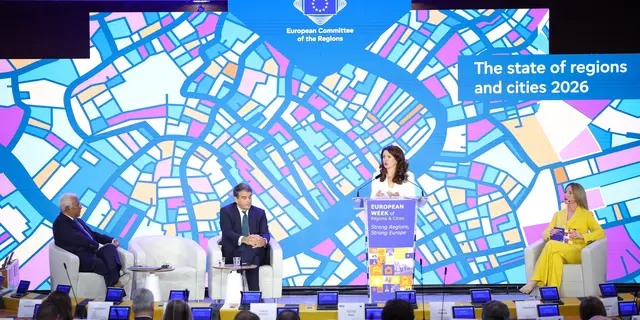

Eight months before the EU elections, President Cordeiro said that more cohesion and a stronger role given to regional and local authorities are the antidote to growing discontent in Europe
The President of the European Committee of the Regions, Vasco Alves Cordeiro, delivered his annual address on the State of Regions and Cities in the European Union, which coincides with the publication of the 2023 EU Annual Report on the State of Regions and Cities, during the opening event of the European Week of Regions and Cities . The Report includes a survey, conducted in cooperation with IPSOS, of local and regional leaders in all of the 27 EU Member States.
The President of the European Committee of the Regions, Vasco Alves Cordeiro, started his speech by underlying that regions and cities have been managing more and more crises: "2023 already is a record year – for unfortunate reasons. The hottest summer ever recorded. With this extreme heat came wildfires, heatwaves, droughts, but also storms and floods." The climate crisis "takes lives, ruins our economy and threatens our future", he stressed, but it also "reinforces inequalities. And this can lead to consequences and impacts that start with climate, economy or infrastructures but can also affect political institutions and democracy", recalling that "without the involvement, without the mobilization of regions and cities it’s not possible to translate global commitments to local actions."
On the reconstruction of Ukraine and the support of cities and regions, he added: "The European Committee of the Regions will play its role to ensure that the local and regional dimension is taken into account and key policies, such as cohesion policy, continue being a central investment capacity for the long-term across all territories. Enlargement is not only a question of numbers and budget. It is a political commitment and it will happen in the interest of candidate countries but also in the interest of the European Union. We need to be ready for this historical step in our common European journey and we need to be aware that whatever the cost may be, it would be much costlier to close the door of Europe to the ones who want to be part of this amazing political journey."
As presented in the report, social inequalities are rising across Europe: over 32 million Europeans are not able to afford a proper meal every other day and 40 million were not able to keep their homes warm in 2022. For President Cordeiro, "social cohesion across our territories is still a goal. Local and regional authorities are the first to cope with the challenges and are the first to answer despite the costs." He called for "European solutions, with local energy and food productions and tailor-made support to people in need, especially the most vulnerable."
To answer these challenges and to achieve the green and digital transitions, while addressing the demographic change, "public investment is the key", he added, "to our objective of territorial, social and economic cohesion in Europe." For President Cordeiro, it is clear that "making cohesion policy fit for future relies on simple ideas: flexibility with predictability, partnership, and accountability", and "we need to work in partnership with all regions and cities. This why we need to reinforce the Code of Conduct on partnership."
President Cordeiro concluded underlying the role local and regional authorities play in their communities: “the success of ambitious policies needs a crucial ingredient: trust. […] The data shows that [citizens] put more trust [in local and regional representatives] than they put in their national governments. Even more trust than they put in the institutions of the European Union." In view of the European elections in 2024, President Cordeiro said that regions and cities, “have a role to play even though our names might not be on the ballot. We have a responsibility to show that democracy delivers at all levels". He stressed that "a stronger role for regions and cities in the EU will be crucial ahead of the great challenges we face, ahead of enlarging our Union. This can only strengthen our common democratic fabric", calling for "policies thought on the ground and a reinvigorated European democracy, with regions and cities at the heart."
Some of the key findings of the EU Annual Report on the State of Regions and Cities are:
Four in ten EU cities and regions (45%) believe that they can contribute to Ukraine’s reconstruction in some way. The Alliance of Cities and Regions for the Reconstruction of Ukraine set up by the CoR and many partners in June 2022 is helping to fill in the gap in sub-national cooperation.
More information:
Full speech of President Vasco Alves Cordeiro: text and video.
Pictures from the speech and the opening session of the #EURegionsWeek.
Entire EU Annual Report on the State of Regions and Cities and Factsheet.
Regional and Local Barometer survey.
Previous editions of the Report.
Contacts:
Monica Tiberi – Spokesperson of the President
Mobile: +32 479 51 74 43
Uoči ključnog sastanka šefova država i vlada EU-a lokalni i regionalni čelnici i čelnice upozorili su da bi u sljedećem dugoročnom proračunu Unije moglo doći do koncentracije odluka na razini…