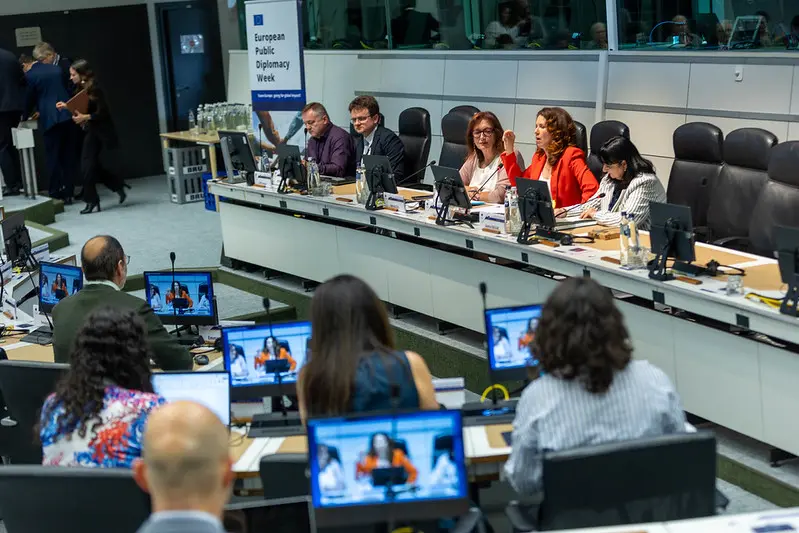
Meeting location: European Committee of the Regions building, room JDE 52
On 30th September and 1st of October, the European Committee of the Regions (CoR) is joining forces with other EU institutions to organise the second editions of the European Public Diplomacy Days. As in the first edition, the overall purpose of the event is to strengthen the EU capacity to convey its common message of attachment to a rule-based multilateral order promoting prosperity, stability, security, peace, and the rule of law. At a time where the multilateral, rules-based world order is increasingly being challenged, the Diplomacy Days increase the ‘Team Europe’ approach to public diplomacy among EU institutions and EU Member States by fostering collaboration and highlighting collective achievements.
In a context of international turbulence, rising armed conflict and other evolving threats, the debate on the participation and role of women in foreign affairs and international security is a timely and relevant one. Despite the growing body of evidence regarding the positive effect of including women in several key areas, women continue to be under-represented in the field of foreign and security policy across the world. This is a directly relevant topic to the Irish Presidency of the Council, as Ireland has a long tradition of female leadership, from figures of the past like Queen Maeve and Gráinne Mhaol the Pirate Queen to today's President Connolly. Showcasing women's experience and perspectives reinforces Ireland's commitment to equality, representation, and community-informed diplomacy in addressing European and global challenges.
The meaningful participation of women in foreign policy promotes inclusive consensus-building - countries such as Spain, France, Germany and Canada have developed dedicated policies in that respect. These approaches aim to reshape diplomatic priorities by bringing gender equality and human rights issues to the negotiation table, and by promoting the ratification of international treaties such as the Istanbul Convention on violence against women. Against this backdrop, the 24th of June is now recognised as the International day of women in diplomacy by the UN.
At the EU level, Gender Equality Action Plan III (GAP III) is the European Union's commitment to promoting gender equality and women’s empowerment in EU external relations, aligning with international commitments and the Sustainable Development Goals.
Local female elected officials are pivotal actors in advancing the contribution of women to foreign policy and strengthening EU public diplomacy. Their leadership at municipal and regional levels not only drives gender equality in local governance but also amplifies the EU’s commitment to inclusive, rights-based external action. Their engagement in public diplomacy initiatives - such as city-to-city cooperation, local dialogues, and participation in EU-funded projects - strengthens Europe’s narrative as a champion of equality and inclusion. Moreover, female local leaders are recognised for their capacity to build consensus, mediate in divided communities, and promote inclusive solutions to complex challenges, all unique assets for the EU’s diplomatic engagement in fragile or sensitive contexts. GAP III recognises their role as essential for translating policy into practice, fostering consensus, and ensuring the meaningful participation of women in shaping Europe’s global narrative.
The objective of the session will be to highlight the link between local female elected officials and the EU’s foreign policy and public diplomacy. Local women leaders ensure that gender equality is not only a policy objective but a lived reality for communities across Europe and beyond, and this will become apparent through this session. Empowering and supporting these leaders is fundamental to the successful implementation of GAP III and to the EU’s global standing as a promoter of equality, peace, and prosperity.
This event has reached full capacity for in-person attendance – registration is now closed. Online attendance is possible - webstreaming links will be made available on this page.