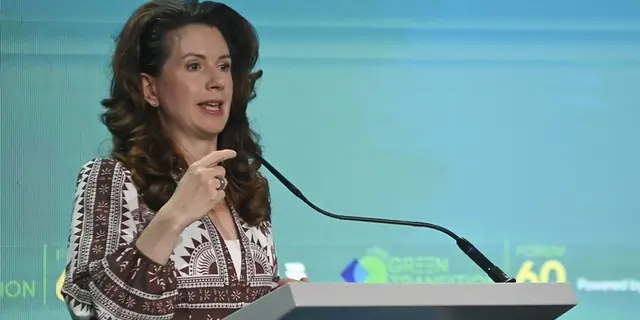
Theresa Sostmann
Theresa.Sostmann@cor.europa.eu

While several national governments seem ready to back up from decarbonisation goals, local and regional authorities are intensifying their work to deliver the green and digital transitions on the ground, mobilising private and public sector to make them socially and economically sustainable. In the two opinions on the Clean Industrial Deal and Clean Transition Dialogues adopted during the plenary session on 2 July, the European Committee of the Regions (CoR) stressed the need for a coherent EU industrial policy that aligns with climate goals while reinforcing Europe's economic and strategic autonomy.
Local and regional leaders welcomed the Clean Industrial Deal as a long-awaited and timely growth strategy to decarbonise EU industry and reinforce its global competitiveness. In the opinion, they underlined the essential role of local and regional authorities as innovation platforms, project facilitators and industrial ecosystem builders, stressing the need for strong regional self-governance, fiscal autonomy and place-based approaches to tailor the industrial transition to local strengths and challenges.
CoR members stressed the importance of aligning EU funding tools, enhancing multi-level governance, and ensuring that LRAs are fully involved in the design and implementation of industrial strategies. They also highlight the need for better data, monitoring tools, and cooperation to enable evidence-based policymaking. They highlighted several critical tools to support industries in the clean transition, including the full implementation of EU measures for simplification and public procurement, the mobilisation of both public and private resources, targeted investment and state-aid frameworks, innovative and smart specialisation strategies, and stronger partnerships between public actors, enterprises, academia and skills providers. Local leaders also emphasised the need to reduce energy costs by increasing the production of clean energy.
Building on its call for better funding alignment, the CoR also adopted an opinion stressing that local and regional authorities must go beyond EU financing by mobilising both public and private resources to ensure effective follow-up to the Clean Transition Dialogues at the local level.
The opinion calls on the European Commission to regularly include local and regional authorities in transition dialogues, as cities and regions have a key role as clusters for renewable energy production, the circular economy and decarbonisation. Their collaboration with businesses, universities, schools and vocational schools is essential to create eco-systems of skills development, innovation and businesses in clean and circular technology and energy systems.
Regions and cities highlighted the need for greater mobilisation of private investments in green projects by leveraging market-based mechanisms and by providing attractive investment-friendly and stable regulations. They also underlined the importance of public-private partnerships in boosting research, technological development, and innovation.
Quotes
William Elofsson (SE/EPP), Second Deputy Mayor of Gävle and rapporteur on the opinion on the Clean Industrial Deal: “Today’s plenary session made it clear: Europe’s green and industrial transitions will only succeed if we build on local strengths and embrace regional diversity at the heart of EU decision-making. Local and regional authorities must be at the centre of Europe’s industrial transformation, with the right tools to innovate, decarbonise, and deliver. From smarter permitting to fairer energy systems and stronger skills development, this opinion outlines how we can build a competitive, resilient, and climate-neutral Europe - together.”
Åsa Ågren Wikström (SE/EPP), Regional Councillor of Västerbotten and rapporteur on the opinion on More than funding: local and regional authorities mobilising public and private resources for an effective follow-up on the Clean Transition Dialogues on the ground: “As local and regional authorities, we are not just implementers of policies. We are front-runners – shaping the Europe of tomorrow. But I truly believe that we as the EU - together – could do more. As the title of the opinion says, it’s about more than funding. It’s about creating an industrial symbiosis for local innovation and partnerships. For us, this is about jobs and development in all our regions. That’s how the clean transition will succeed.”
Background
On 25 February, the European Commission presented the Clean Industrial Deal, which outlines concrete actions to turn decarbonisation into a driver of growth for European industries. This includes lowering energy prices, creating quality jobs, and the right conditions for companies to thrive.
Contact
Theresa Sostmann
Tel: +32 475999415
Theresa.Sostmann@cor.europa.eu
Sweden
Member
Member of County Council, Västerbotten Region


Sweden
Alternate
Second Deputy Mayor of Gävle Municipality

Last summer's record heatwaves, wildfires and other extreme weather events across Europe again proved the urgency to tackle climate change and strengthen resilience at all levels of government…
After one of the most extreme heatwaves ever recorded in central and western Europe, cities and regions are urging the EU to ensure that the next long-term EU budget includes clear and dedicated…
European Committee of the Regions President Kata Tüttő on 4 June called for a stronger, decentralised EU investment policy to support competitiveness, resilience and the green transition, arguing…