Romania

Csaba BORBOLY
Member
Vice-president of the Harghita County Council

EPP (European People's Party)

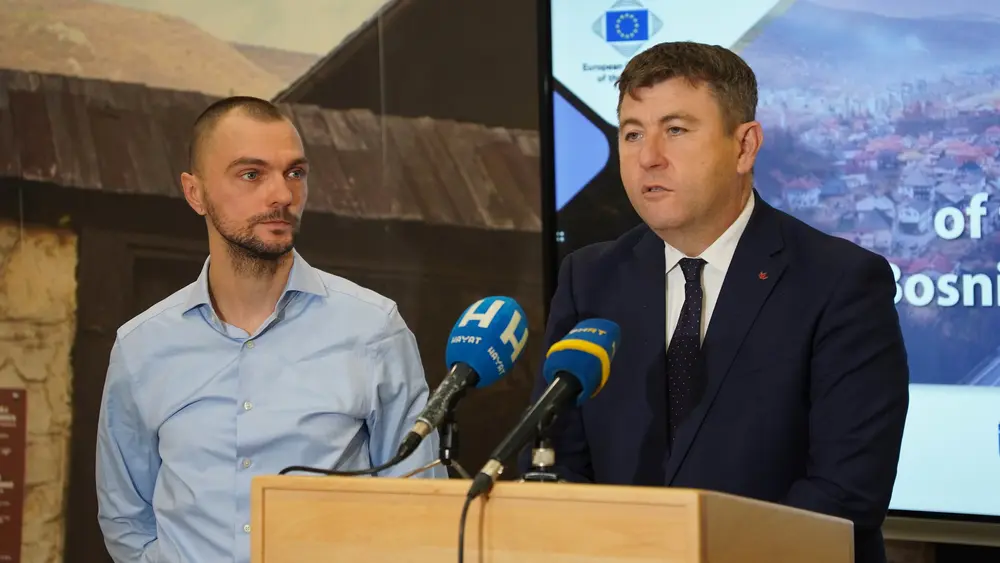
Members of the European Committee of the Regions (CoR) on 5 November urged local and regional leaders in Bosnia and Herzegovina to accelerate reforms recommended by the European Union and to seize the opportunities to build administrative capacity offered by EU funding.
The delegation of CoR members, led by Csaba Borboly (RO/EPP), met local and regional leaders in Travnik in the framework of the CoR's Working Group on Bosnia and Herzegovina. They reiterated their support for Bosnia and Herzegovina's accession to the EU, while underscoring that enlargement is a merit-based process.
The CoR members were in Bosnia and Herzegovina at the invitation of Kenan Dautović, mayor of Travnik and president of the Association of Cities and Municipalities of the Federation of Bosnia and Herzegovina. The Association of Cities and Municipalities of Republika Srpska was also represented, by Milan Zečević.
The CoR delegation also exchanged views with the EU's ambassador to Bosnia and Herzegovina, Luigi Soreca, and Goran Behmen, ambassador at large at the Ministry of Foreign Affairs of Bosnia and Herzegovina.
The Working Group, which was created in 2025, meets twice a year to review progress at the local and regional level on reforms required by the EU prior to accession to the EU and to discuss a topic of particular concern for local and regional authorities. In Travnik, there was a dedicated discussion about how local and regional administrations can benefit from access to EU funding and programmes and about the administrative capacity needed.
The visit came a day after the European Commission issued its latest report on Bosnia and Herzegovina's progress on EU-related reforms. Presenting its main findings, EU Ambassador and European Union Special Representative in Bosnia and Herzegovina, Luigi Soreca, described progress over the past year as uneven, called for renewed reform momentum, and highlighted that local and regional authorities can also play an important role in the implementation of country’s Reform Agenda.
Quotes:
More information:
Romania
Member
Vice-president of the Harghita County Council