


European security will be built in Europe’s regions – or it will not be built at all
On this page
- Enterprise and Industry
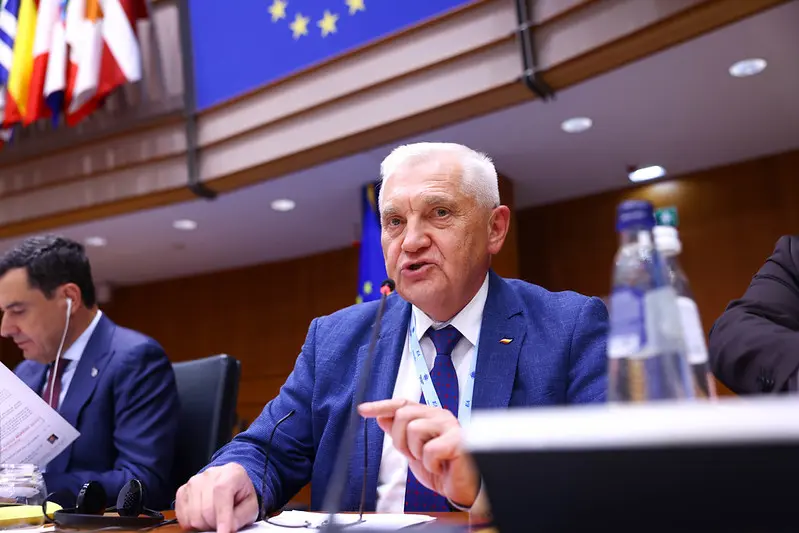
Europe must turn the strengths of its regions into greater security, industrial capacity and resilience.
Russia’s continuing war of aggression against Ukraine and a rise in cyber-attacks, sabotage and other hybrid threats have brought Europe’s security challenges closer to its citizens. In an opinion adopted on 13 October, the European Committee of the Regions (CoR) calls for faster implementation of the EU Defence Industry Transformation Roadmap and for regions and cities to be fully involved in strengthening Europe’s industrial capacity.
In the opinion drafted by Tadeusz Truskolaski (PL/EA), Mayor of Białystok, the Committee argues that Europe needs a more geographically diverse and more integrated and interoperable defence industry, with stronger supply chains and closer cooperation between regions.
The CoR cites Russia’s war on Ukraine, and cyber-attacks, sabotage, attacks on critical infrastructure and repeated drone incursions into European airspace as evidence of a fundamentally changed security environment that requires a coordinated European approach to detection, protection and response, rather than fragmented national efforts.
Defence investment should strengthen Europe’s regions
The CoR wants the European Commission and Member States to map out regional capabilities and specialisations so that investment can be directed where it will have the greatest impact. It says SMEs, start-ups, industrial clusters, universities, research centres should be involved from the outset, alongside larger defence companies.
Promising ideas should have a clearer route from testing to procurement and production, the opinion argues. The CoR also calls for simpler access to finance, procurement and certification, a shorter pathway from innovation to market and less administrative burden, while maintaining transparency and environmental, social and security safeguards.
Defence funding should do more than increase production, the CoR says. Investment should create skilled jobs, help local companies grow, improve dual-use infrastructure and support innovation with civilian applications. The CoR stresses that this investment should complement Cohesion policy rather than divert money away from regional development.
The opinion calls for clear commitments to ensure that new EU investments and opportunities are open to SMEs, benefit regional economies, boost skills, enhance supply-chain resilience and promote the geographical spread of production. It also highlights the particular needs of regions bordering Russia, Belarus and Ukraine, which face greater security pressures and require reliable, long-term support.
Ukraine brings valuable experience to Europe’s defence effort
The CoR wants Ukraine to play a greater role in European defence projects and industrial supply chains, arguing that the EU’s and Ukraine’s security are closely linked.
Ukraine has become one of the world’s most dynamic defence innovation environments, particularly in drones, counter-drone systems, artificial intelligence, electronic warfare, digital solutions, logistics and crisis management. Its strength lies not only in developing new technologies quicklyin real operational conditions, gathering immediate feedback and adapting them to emerging threats at exceptional speed - experience that could benefit the European defence industry.
The opinion calls for closer cooperation to allow Ukrainian and European partners to develop, test, procure and produce solutions together. It points to initiatives such as BraveTechEU and the EUDIS Tech Alliances as examples. Europe can provide scale, investment and industrial capacity, while Ukraine contributes agility, practical expertise and solutions already tested in the field.
Quote:
- Tadeusz Truskolaski(PL/EA), Mayor of Białystok and CoR rapporteur: “For the people of Białystok and other regions on Europe’s eastern flank, security is not an abstract issue. The war in Ukraine and the changing nature of threats show how important preparedness, resilience and effective cooperation have become. Our task is not to cause alarm, but to ensure that people feel safe through concrete action. Europe needs unity, industrial capacity and effective response mechanisms to achieve this - not in ten years, but now. Member States and regions must therefore work together to strengthen European supply chains and turn innovation into practical solutions more quickly. Border regions must be full partners in the decisions that shape Europe’s security.”
Background:
- An International Institute for Strategic Studies (IISS) assessment published in July 2026 documented 144 suspected Russian drone incursions across 13 NATO countries and Ireland between August 2024 and February 2026, including incidents affecting airports, military facilities and other sensitive infrastructure. Subsequent incidents in 2026 indicate that the overall number of recorded cases has risen to around 200 and continues to grow.
- The EU Defence Industry Transformation Roadmap is part of a broader effort to improve Europe’s defence readiness by 2030. The Defence Readiness Roadmap 2030 sets capability milestones and proposes four European flagship projects: the Eastern Flank Watch, the European Drone Defence Initiative, the European Air Shield and the European Space Shield. On 3 July 2026, the Commission proposed five European Defence Projects of Common Interest under the €1.5 billion European Defence Industry Programme, with €325 million set aside for their launch and deployment. They cover drones and counter-drone systems, maritime and seabed defence, space, air and missile defence, and security along the EU’s eastern flank. On average, 18 Member States take part in each project, while Ukraine participates in four of the five. Further information is available from the European Commission: joint defence projects; European Defence Industry Programme; Defence Readiness Roadmap 2030. The wider framework also includes the €150 billion SAFE instrument, the Defence Readiness Omnibus and €1 billion under the European Defence Fund’s 2026 work programme.
- The CoR opinion was adopted at the 173rd plenary session on 13 October 2026.
Contact:
Wioletta Wojewodzka
Tel: +32 473 84 39 86
wioletta.wojewodzka@cor.europa.eu