In Chișinău, European Committee of the Regions also launches its new pilot Eastern Partnership Academy for local and regional civil servants.
The inaugural meeting of the Joint Consultative Committee between the European Committee of the Regions and the Republic of Moldova that took place on 15 September in Moldova's capital, Chișinău, has sent a strong political signal of support for the country's path towards EU membership. A day earlier, Chișinău also hosted the 15th annual meeting of the Conference of Regional and Local Authorities for the Eastern Partnership (CORLEAP). It zoomed in on foreign information manipulation and launched a pilot online academy for civil servants.
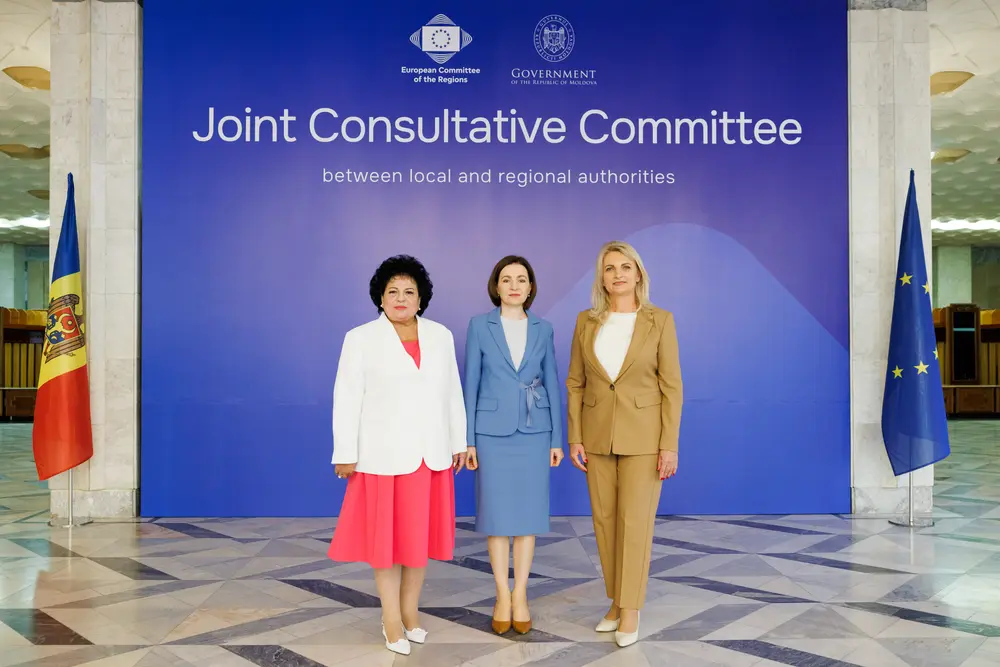
Moldova's President Maia Sandu personally addressed EU and Moldovan local and regional leaders at the first meeting of the Joint Consultative Committee (JCC). In her keynote speech, she called the meeting an important source of momentum for the country as it progresses on the road towards the EU and stressed the role of the new format in the direct exchange of experience, best practices, cultural and school exchanges.
Deepening the dialogue on local and regional level
The JCC endorsed a joint declaration calling for greater decentralisation, financial autonomy, inclusive governance, and structured involvement of local-government associations. The document, initiated at the proposal of a CoR member of the JCC, Emil Draghici (RO/EA), points to the need for dedicated EU support, stronger cross-border cooperation, and alignment with European democratic standards.
It took less than a year-and-a-half to upgrade the CoR's cooperation with Moldova from a Working Group to a Joint Consultative Committee format. This demonstrates strong political support for local democracy and multi-level governance as indispensable components for a successful EU enlargement. The creation of the JCC is a recognition of the vital role of local and regional authorities in Moldova's future within the EU. It reflects a firm commitment by the EU and Moldova to deepen their mutual dialogue and cooperation on local and regional level.
Bridging decision-making and implementation
With the JCC, the CoR and Moldova have laid the foundation for a long-term partnership that will ensure that local and regional authorities on both sides become actively involved in the country's accession process. The forum will help identify specific needs, propose practical solutions and policy recommendations based on experience in the EU Member States and other associated countries. It offers a consultation platform on dedicated support provided through the Reform and Growth Facility and on funding available in the next EU budget. It is a venue for peer-to-peer exchanges between municipalities and regions – both at political and technical levels – for vital knowledge transfer and joint projects that can help accelerate Moldova's EU integration. Not least, the JCC aims to reinforce institutional partnerships, such as with the Congress of the Council of Europe.
On an EU level, the JCC's insights on how reforms are perceived and implemented locally will present valuable material for the annual Enlargement Report on Moldova prepared by the European Commission.
Countering foreign information manipulation
On 14 September, Chisinau hosted another important event – the 15th annual meeting of the Conference of Regional and Local Authorities for the Eastern Partnership (CORLEAP). At the heart of the discussion were foreign information manipulation and interference (FIMI) as well as the situation of local and regional media in the Eastern Partnership countries. Moldova – alongside Ukraine – is among the primary targets of FIMI due to its EU accession process and strategic orientation. Recent elections have seen increasingly sophisticated interferance involving coordinated online campaigns, disinformation networks and attempts to shape public attitudes towards the country's process of European integration.
Capacity building for local and regional civil servants
During the CORLEAP meeting in Chișinău, the CoR launched its pilot project for an Eastern Partnership Academy for Public Administration at Local and Regional Level (EPA) that would give civil servants from partner countries direct access to European institutions, expert knowledge, and real examples from EU cities and regions. Online courses will be offered in the languages of the participants. The curriculum will include practical insights into how EU cities and regions solve everyday problems and will enable networking with peers across borders. The pilot academy will take place in the first half of 2027.
Quotes:
- Kata Tüttő (HU/PES), President of the European Committee of the Regions: “The participation of President Maia Sandu in today's inaugural meeting of the Joint Consultative Committee is a clear sign of the perfect momentum in Moldova's path to EU accession. Moldova has made a clear and courageous choice to move towards the European Union. The European Committee of the Regions stands firmly behind this choice. We believe that enlargement is not only about negotiating chapters and aligning legislation. It is about bringing Europe closer to citizens. And that is why cities, municipalities and regions must be part of the process from the very beginning. The Joint Consultative Committee will be a powerful lever to make this objective become reality.”
- Maia Sandu, President of the Republic of Moldova: “Our partnership at state level develops in much more concrete form between Moldovan local and regional authorities and their partners in other European countries. This allows direct exchange of experience, best practices, cultural and school exchanges. We welcome the launching of the Eastern Partnership Academy for Public Administration, which will be an important instrument for capacity building for civil servants at regional and local level. The meeting today and the future work of the Joint Consultative Committee between Moldova and the European Committee of the Regions is yet another important momentum in this effort.”
- Mariana Gâju (RO/PES), JCC Moldova Co-Chair and Mayor of Cumpăna Commune, Constanța County: "Moldova’s European future will not be built in negotiation rooms alone. It will be built in every city, town and village, where reforms must make a real difference to people’s daily lives. The new Joint Consultative Committee turns local authorities from observers into partners and gives them a stronger voice in this process. We will work together to ensure that accession strengthens local democracy, improves public services and leaves no community behind."
- Valentina Casian, JCC Co-Chair and mayor of Strășeni Municipality: "Today, we are making an important step, so that the voice of our communities is closer to Europe. The Joint Consultative Committee is a structure that has been expected for a decade. I would like for this platform to establish a constant link to foster an institutional dialogue between the European Union and the national and local levels in the Republic of Moldova. I urge the local authorities to have an active role in the European integration process because European integration cannot be achieved only through decisions and policies. It is built in communities, in schools, in infrastructure and public services of high quality, in efficient, transparent administration close to the people. The Moldovan communities need to be an active part of this European construction."
- Patrick Molinoz (FR/PES), acting CORLEAP Co-Chair and Vice-President of the Region of Bourgogne-Franche-Comté: "Foreign interference aims to manipulate public opinion everywhere. It undermines even the local level, which enjoys the highest level of trust amongst citizens. Cities and regions must therefore have the right tools to ensure their cybersecurity and combat such interference and, more broadly, all forms of disinformation. We call on Europe to support local authorities, independent journalism and media literacy. Protecting our information space is essential to preserving democracy, starting at the local level."
- Constantin Cojocari, CORLEAP Co-Chair and Mayor of Edinet, Moldova: “As a mayor and Co-Chair of CORLEAP, but also as a former teacher and school headmaster, I am delighted that we are launching the Eastern Partnership Academy for Public Administration at Local and Regional Level (EPA) pilot project. It is the implementation of a long-term decision by CORLEAP, and an answer to real and great needs of civil servants in the local and regional public administration in Moldova and other countries of the Eastern Partnership. I hope this pilot project is just the beginning of a full-scale academy."
Background:
- Video recording of the JCC Moldova meeting on 15 September 2026 in Chișinău.
- CORLEAP is the only EU platform that offers an opportunity to discuss the contribution by cities and regions in the development of the EU’s Eastern Partnership countries (Armenia, Azerbaijan, Georgia, Republic of Moldova and Ukraine.) CORLEAP consists of 33 regional and local politicians: 18 members of the CoR and 15 representatives from the five Eastern partner countries. Each Eastern partner country has three seats. The EU seats are distributed according to the CoR's political composition, divided between its six political groups: European People's Party (EPP), Party of European Socialists (PES), Renew Europe (RE), the European Conservatives and Reformists Group (ECR), European Alliance (EA), and the Greens. Between the annual CORLEAP meetings a Bureau acts as a steering body. The Bureau is responsible for coordinating the work of CORLEAP, monitoring its activities, reports and resolutions. It is composed of five members from the partner countries and six members from the CoR representing the EU.
- Moldova was granted EU candidate country status in June 2022. Following the European Council decision in December 2023, negotiations were initiated at the first inter-governmental conference on 25 June 2025. In May 2025, Moldova adopted the 2025-2029 National Programme for the Accession of Moldova; and in July 2025, the first EU-Moldova Summit was held marking a new stage of cooperation and integration. In September 2025, the European Commission concluded its first comprehensive screening reports and technical negotiations on all six cluster were launched in March 2026. On 5 May 2026, the EU-Moldova Parliamentary Association Committee adopted a declaration calling for the formal opening of negotiations, while the government of Moldova has signalled its objective to provisionally close accession negotiations by early 2028. In July 2026, Moldova's European integration has entered a new phase with the opening of a second EU accession negotiation cluster - on Cluster 6, 'External Relations'. The Reform and Growth Facility (EUR 1.9 billion) is a key instrument to support the accession process. Under the next MFF, EU's cooperation with the candidate countries is expected to be guided by the National and Regional Partnership Plans.