France

Magali ALTOUNIAN
Member
Regional Councillor of the Region of Sud-Provence-Alpes-Côte d’Azur

Renew Europe

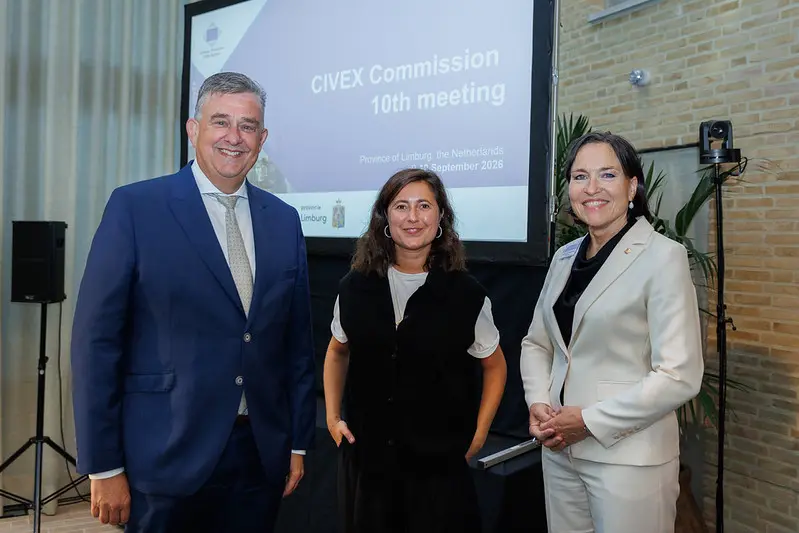
Conference on democratic resilience held alongside discussions on Ukrainian refugees, the Mediterranean and counter-terrorism at CIVEX meeting in the Netherlands.
Three sets of recommendations on 9 September passed through the commission stage at the European Committee of the Regions (CoR) — on support for Ukrainian refugees, on implementation of the Pact for the Mediterranean, and on counter-terrorism.
Members of the Commission for Citizenship, Governance, Institutional and External Affairs (CIVEX) also held an early discussion on a critical aspect of the European Commission's 'better regulation' and 'simplification' agenda.
The meeting, which was held in Eijsden in the Dutch province of Limburg, was coupled with a conference democratic resilience.
Meeting documents and a recording of the CIVEX meeting and the conference are available on the event page.
'Celebrating 80 Years of Freedom: Democratic Resilience for the Way Ahead'
The conference, 'Celebrating 80 Years of Freedom: Democratic Resilience for the Way Ahead', came a month before the CoR is scheduled to adopt proposals on a priority dossier - the establishment of a European Democracy Shield with proposals to foster trust, resilience, and preparedness in democratic systems. The importance of the topic was underlined by the chair of CIVEX, Magali Altounian (FR/Renew Europe), who said in her opening speech that "the defence of these values and principles has never been so urgent, and never has the mobilisation of elected officials and citizens been so necessary".
During the first of two sessions, think-tanks associated with the European political groups set out some of their principal concerns and proposals to reinforce democracy at the local and regional level, by building back the trust to political institutions and political participation. A trans-Atlantic perspective was provided by Hélène Drainville, Delegate-General of Québec in Brussels, who said Québec has a highly successfully programme to educate young people about democracy, can sanction against anyone who wilfully spreads disinformation to overturn elections or destroy trust in the electoral process, and in 2018 adopted the Montreal Declaration for the Sustainable Development of Artificial Intelligence to help develop an ethical framework for the development and deployment of AI.
The second session was an inter-generational conversation between members of the CoR and pupils from schools in the Province of Limburg, focused on disinformation, democracy, the war in Ukraine and EU enlargement. Elianne Demollin-Schneiders (NL/N.I.), Regional Minister of the Province of Limburg, who moderated the discussion said: "To protect our democracies, we need to listen to young people on a frequent basis. We need to make such intergenerational dialogues a common practice in our cities."
Historical perspectives linking remembrance, democracy and the European project were provided by the mayors of Eijsden-Margraten and Dunkirk. Alain Krijnen of Eijsden-Margraten identified hospitality, curiosity, and responsibility as essential elements in the effort to maintain the vitality of democratic institutions. Patrice Vergriete of Dunkirk underlined the importance of preserving a collective memory of war, violence and civilian suffering. Dunkirk leads the Cities of Remembrance initiative that brings together cities aiming at promoting peace, reconciliation, and democratic values.
Other major take-aways included the need for concerted efforts to promote a positive narrative about democracy and to equip young people with the skills to face challenges such as fake news.
'From Temporary Protection to Sustainable Solutions for Displaced Ukrainians in the EU — the role of cities and regions'
Current estimates suggest that 4.4 million Ukrainians enjoy temporary protection rights to stay in the EU because of Russia's ongoing war in Ukraine, a status that gives them eased access to residence, health care, education, and social support. In an own-initiative report, drafted by Antje Grotheer (DE/PES), president of Bremen City Parliament, the CoR argues that the EU and its member states now need to move beyond issues of short-term reception towardssustainable solutions that provide them with legal certainty about their rights in the EU beyond March 2028 - when their rights will next be subject to renewal - while helping those who wish to return to Ukraine.
The opinion attempts to ensure that local and regional authorities, which are responsible for much of the work of welcoming and supporting Ukrainians, are systematically involved in designing and implementing the transition beyond temporary protection. It argues that an investment in time and money in supporting their integration - including into the labour market - can benefit the communities where they currently live, but also Ukraine's recovery tomorrow.
Speaking on behalf of rapporteur Grotheer, Toomas Sarapuu (EE/PES), vice-chairman of Võru City Council, said: "Temporary protection cannot mean permanent uncertainty. Ukrainians displaced by Russia’s war have built lives in our communities, their children attend our schools and they contribute to our societies. Europe now needs sustainable solutions that give people clarity for the future and provide cities and regions with adequate, predictable support."
The opinion is scheduled for adoption at the CoR's plenary session in October.
'ProtectEU: Agenda to prevent and counter terrorism'
Members of CIVEX approved an opinion on the EU's agenda to prevent and counter terrorism, in which they focused particularly on the security of public spaces and infrastructure and on the role of local and regional authorities in areas crucial to the prevention of radicalisation, such as education, social policy, culture, youth, and social inclusion.
The rapporteur — Olgierd Geblewicz (PL/EPP), president of West Pomerania Region — emphasised that terrorism cannot be looked at "through the prism of the attacks we have witnessed over past decades", with threats now more dispersed, increased use of the internet and new technologies, an increased risk of radicalisation among the young, and a changing geopolitical situation. "Security starts locally," he argued. "Prevention takes place at the local and regional level, where schools, cultural institutions, civil society organisations and local services can identify the first signs of radicalisation."
He continued: "Cities and regions are responsible for a significant part of Europe’s critical infrastructure - hospitals, public transport, water supply systems and other essential services. We therefore cannot expect local and regional authorities to effectively protect our citizens and infrastructure without the appropriate tools, competences and funding."
The meeting was addressed by MEP François-Xavier Bellamy (FR/EPP), who emphasised the "importance of recognising and guaranteeing the responsibility of regional and local authorities". The ProtectEU agenda is currently being considered by three European Parliament committees.
The opinion is scheduled for adoption by the CoR at its plenary in October.
'The Pact for the Mediterranean: One Sea, One Pact, One Future'
With the EU's Pact for the Mediterranean heading towards its first anniversary in November, the CIVEX commission adopted an opinion that urges the European Commission to strengthen its planning mechanisms so that local and regional authorities can contribute to the identification, implementation, and monitoring of the Pact's Action Plan.
The Pact is built on three pillars — 'peace', 'prosperity' and 'stability' — and its Action Plan currently has 21 points, a number that will increase to 28, the European Commission told CIVEX members, with the addition of initiatives related, for example, to science, sport, trade and transport.
The opinion argues the greater attention is needed to the territorial dimension of cooperation. Members of CIVEX and the European Parliament's representative — MEP Leoluca Orlando (IT/Greens-EFA) — placed particular emphasis on challenges facing islands.
The CoR's rapporteur — Magali Altounian (FR/Renew Europe), member of the Provence-Alpes-Côte-d'Azur Regional Council — said: "The success of the Pact for the Mediterranean will largely depend on its ability to mobilise local and regional authorities as true partners, to connect its thematic pillars with one another, and to build on the many existing initiatives and cooperation frameworks in the Mediterranean."
The opinion will go to the CoR plenary session in December for adoption. In late October, the CoR and local and regional partners from around the Mediterranean will, at the annual meeting of the Euro-Mediterranean Regional and Local Assembly (ARLEM), adopt a joint opinion on 'Delivering the Pact for the Mediterranean with local and regional authorities'.
'A Simpler, Clearer and Better Enforced EU Rulebook'
The last legislative item on the CIVEX agenda was a preliminary debate on a communication, published by the European Commission on 28 April, for 'a simpler, clearer and better enforced EU rulebook'. Presenting his initial thoughts, the CoR's rapporteur — Matteo Luigi Bianchi (IT/ECR), member of Morazzone local executive — described the goals as "laudable" but underlined that "simplification must go hand in hand with subsidiarity".
The debate, which included contributions from academics from the University of Maastricht, raised concerns about the proposal's effects on impact assessments, about centralisation, about possible misuse of 'urgency' as a justification for deregulation, and the use of artificial intelligence in compliance and monitoring.
Rapporteur Bianchi said: "Better regulation means first and foremost avoiding unnecessarily complex rules, reducing administrative burdens and focusing Union action on what delivers genuine European added value. Simplification and competitiveness are closely linked: less bureaucracy and greater legal certainty are essential, especially for small and medium-sized enterprises and for the proper functioning of the Single Market."
CIVEX will vote on the opinion in November, with adoption foreseen for the plenary session in February 2027.
France
Member
Regional Councillor of the Region of Sud-Provence-Alpes-Côte d’Azur
Italy

Member
Member of the Local Executive of Morazzone (VA)


Netherlands

Member
Regional Minister of the Province of Limburg

Poland

Member
Councillor of the Zachodniopomorskie Voivodeship


Germany

Member
President of the Bremen State Parliament


Estonia

Alternate
Vice Chairman of Võru City Council
