Tá na réigiúin agus na cathracha ríthábhachtach maidir le cur chuige ‘omnibus’ an Choimisiúin Eorpaigh lena moltar treoracha a athbhreithníodh le déanaí a athoscailt, agus tathantaíonn siad ar an…
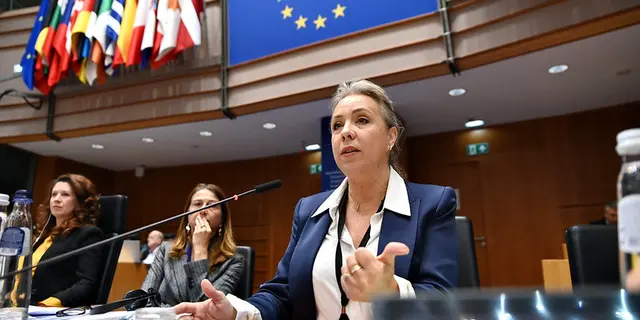

Just a week ahead of the COP28, the CoR's Commission for Environment, Climate Change and Energy (ENVE) held a debate with high-level representatives of the European Commission to assess the progress made in the EU's energy and climate transition. While the EU’s net greenhouse gas emissions decreased by around 3% in 2022, the EU and Member States still need to accelerate emissions reduction to achieve climate neutrality by 2050. This is becoming even more urgent as record temperatures, heavy floods, wildfires and other climate disasters are impacting infrastructure and people's health across Europe.
Formally recognising the contribution of local and regional governments to the climate targets and providing them with adequate support will be key priorities for the CoR delegation at the COP28, to be held in Dubai from 30 November to 12 December.
"The CoR's annual report on the State of Regions and Cities in the EU shows that local and regional authorities are investing into becoming more resilient, committing to 2050 climate neutrality targets while also developing climate adaptation strategies for our cities and regions. The number of best practices is steadily growing. But there is still a lack of funding to support regions and cities investments in climate adaptation and resilience. This is a reality that we need to acknowledge and act upon", said ENVE commission chair and Mayor of Warsaw Rafal Trzaskowski.
During the debate at the ENVE Commission, European Commission representatives presented the key findings of the 8th report on the State of the Energy Union that was published in the end of October. Yvon Slingenberg, Acting Deputy Director General for Climate Action (DG CLIMA), highlighted that more efforts are still needed especially in construction and transport sectors and emphasised the role of local and regional authorities in mobilising local stakeholders. Pierre Schellekens, Director for Energy policy Strategy and Coordination (DG ENER), pointed out that Europe has managed to reduce its demand for energy after Russia's invasion of Ukraine, saving 18% of gas compared to 5 previous years and building up stocks, and accelerated the deployment of renewables: in May 2023, wind and solar surpassed for the first time total fossil electricity generation.
Green Deal and Health
The European Environment Agency estimates that various forms of environmental pollution are responsible for one in eight deaths per year in the European Union. Air pollution alone is causing more than 300 000 premature deaths per year in Europe, and 18% of cardiovascular diseases and 10% of cancers are related to environmental degradation. ENVE members adopted a draft opinion on Green Deal and Health that has been prepared by Juan Manuel Moreno Bonilla (ES/EPP), President of Andalusia.
"Local and regional authorities play an essential role in designing and implementing the Green Deal measures and mitigating the impacts of climate change, pollution and environmental degradation on human health", the rapporteur said. He pointed out that cities and regions need both financial support and technical assistance, and underlined the importance of closer cooperation between the different levels of government and sectors involved in implementing the measures especially in the field of health, environment, urban planning and transport.
Soil Monitoring and Resilience
The proposal for a directive on Soil Monitoring and Resilience is a key piece of the EU's zero-pollution ambition. The CoR draft opinion prepared by Frida Nilsson (SE/Renew Europe), Member of Lidköping Municipal Council, welcomes the European Commission's ambition to achieve healthy soils by 2050 and stresses that healthy soil is an essential basis for the European economy, for achieving climate neutrality and zero pollution, halting and reversing biodiversity loss, achieving food and water security and preserving public health.
The rapporteur, however, expressed some concerns on the possible administrative burden on local and regional authorities. "I want to make sure that the proposed framework for monitoring and assessment is flexible enough to take into account the widely differing situations at the local, regional and national level in terms of ecosystems, soils, climatic conditions and administrative structures across the EU", she said in a recent interview for the European Commission's Zero Pollution Stakeholder Platform newsletter.
Other opinions
At the ENVE Commission meeting on 22 November, members also exchanged views on an upcoming opinion on Localising energy production: the role of geothermal energy, presented by József Ribanyi (HU/ECR), Member of Tolna Megye County Council. Rapporteurs were appointed for the following opinions:
The next ENVE Commission meeting will take place on 8 February 2024.
Tá na réigiúin agus na cathracha ríthábhachtach maidir le cur chuige ‘omnibus’ an Choimisiúin Eorpaigh lena moltar treoracha a athbhreithníodh le déanaí a athoscailt, agus tathantaíonn siad ar an…
Tá na réigiúin agus na cathracha ag tathant ar an gCoimisiún Eorpach caitheamh le truailliú torainn mar phríomh-shaincheist sláinte poiblí agus comhshaoil, rud a mbeidh tionchar aige freisin ar…

Chuir ceannairí áitiúla agus réigiúnacha in iúl gur meabhrú lom iad na tuilte a tharla le déanaí in Iardheisceart na hEorpa ar an ngá atá le hacmhainneachtaí na n-údarás áitiúil agus réigiúnach a…
